Kettlebell Workout for Beginners: Full-Body Routine to Build Strength at Home
A step-by-step kettlebell workout for beginners — the 5 foundational moves, a 4-week progression, and how it stacks up to dumbbells for home training.
A kettlebell workout for beginners is one of the most efficient ways to build full-body strength, cardiovascular endurance, and coordination — all without needing a gym membership or a basement full of equipment. One cast-iron bell, maybe four square feet of floor space, and 30 minutes three times a week is enough to drive real, measurable change. This guide walks you through the five foundational kettlebell moves every beginner should learn, a four-week progression, and how kettlebells compare against dumbbells so you can make a smart buying decision for your home setup.
Key Takeaways
- A 20-minute kettlebell snatch workout burns roughly 20.2 calories per minute — equivalent to running a 6-minute mile (ACE, 2010)
- Kettlebell pressing recruits approximately 20% more shoulder stabilizer activity than a dumbbell press of the same weight due to the offset center of mass
- Most men should start with a 16 kg (35 lb) bell; most women with 8 kg (18 lb) — sizing too light is the most common beginner mistake
- Kettlebells cover five key movement patterns in one tool: hinge, squat, press, pull, and carry
- Dynamic warm-ups with resistance-band activation drills improve lift performance by 5–9% over static stretching alone
- After 4 weeks on the foundation program, retest with a 5-minute swing EMOM (50 swings) to benchmark your conditioning progress
Why a Kettlebell Workout for Beginners Works So Well
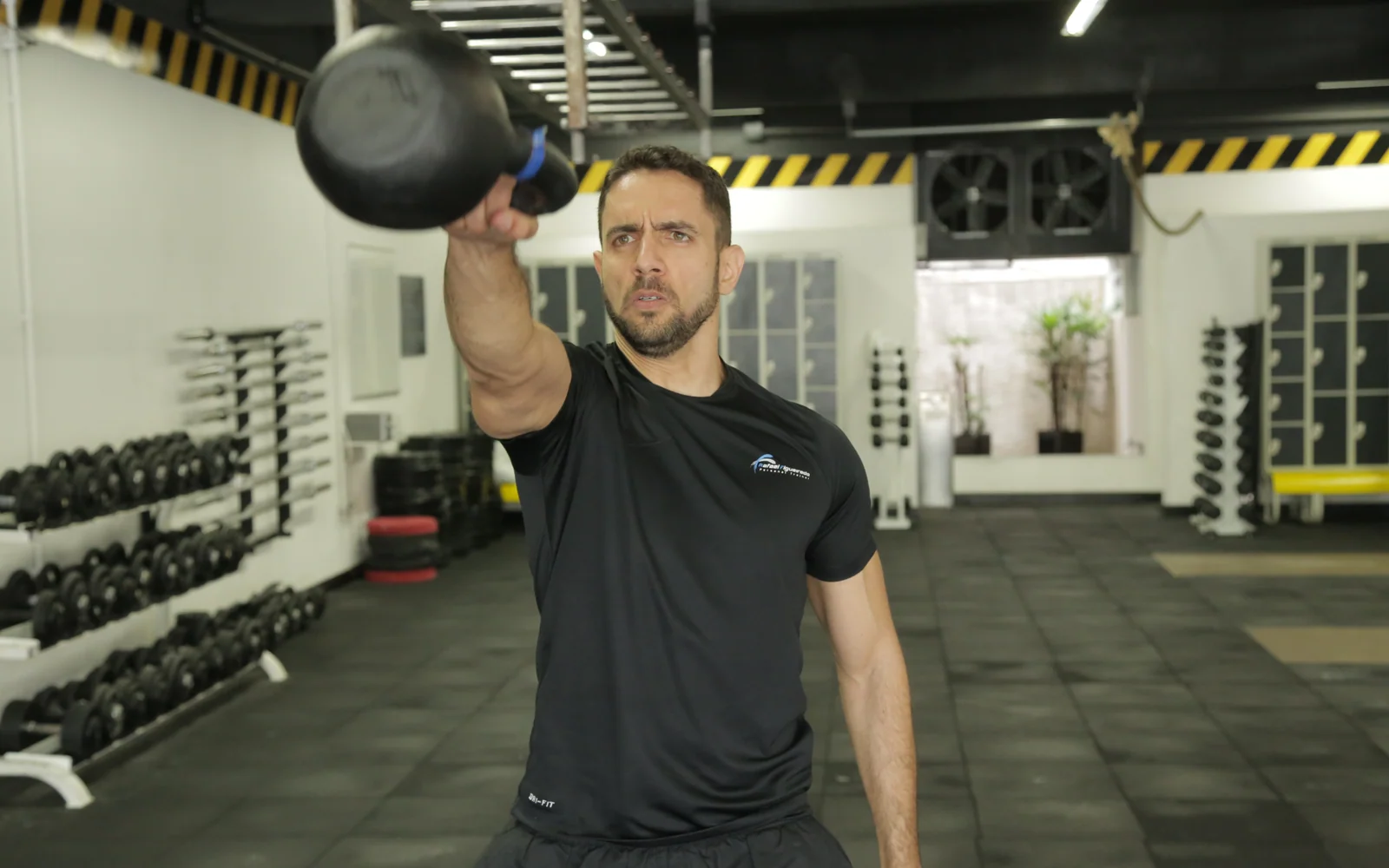
Kettlebells have an offset center of mass — the weight sits below the handle — which forces your stabilizers, grip, and posterior chain to work harder than they do with symmetrical implements. A widely cited 2010 study commissioned by the American Council on Exercise (ACE) found that a 20-minute kettlebell snatch workout burned roughly 20.2 calories per minute, equivalent to running a 6-minute mile. That's a remarkable stimulus for a tool you can store under your bed.
For beginners, the real selling point is training density. A single kettlebell lets you hit nearly every major movement pattern — hinge, squat, press, pull, carry — without switching implements. That's part of why the Russian armed forces built entire conditioning programs around the kettlebell long before the tool went mainstream in the West.
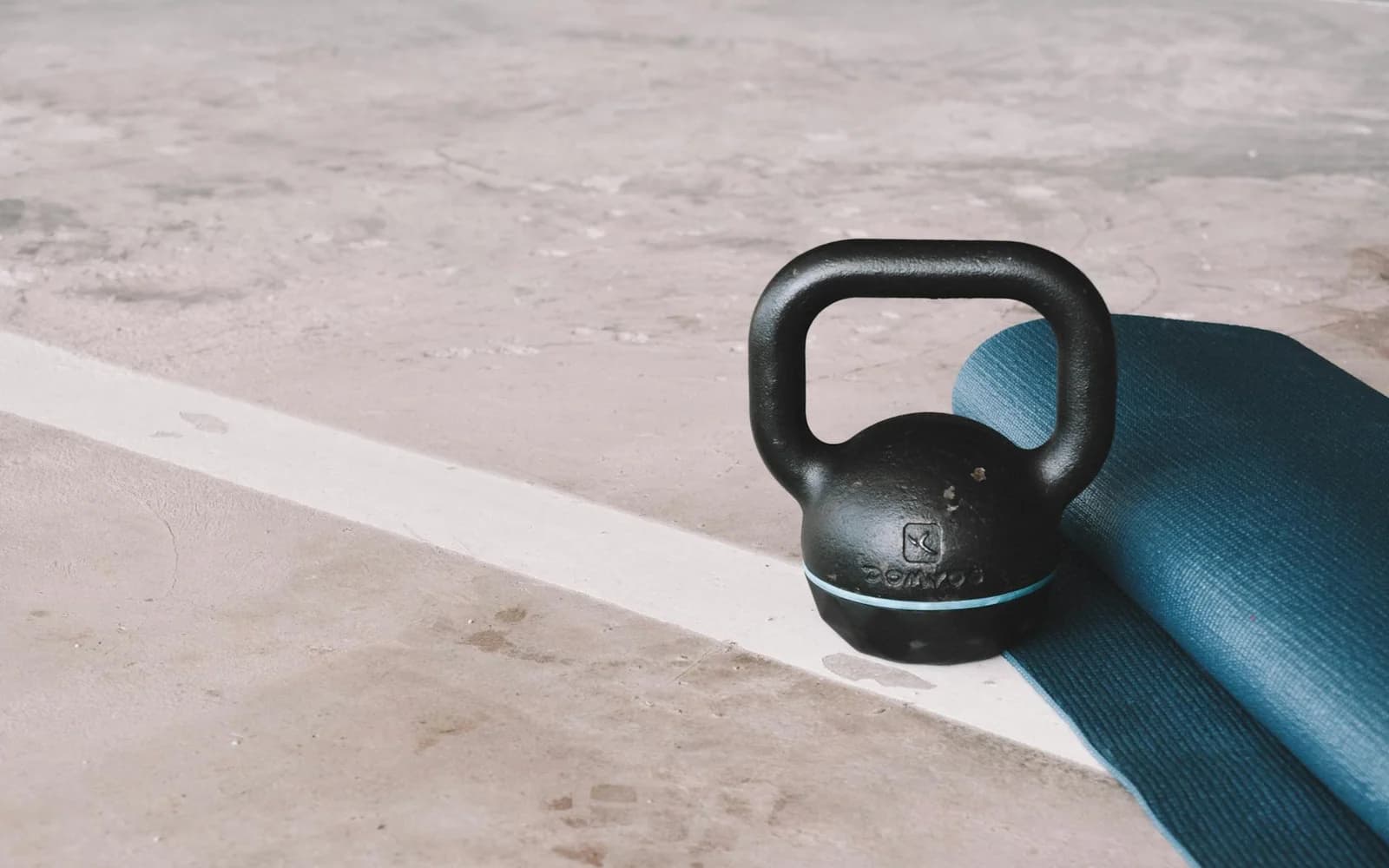
Expert tip: Most men should start with a 16 kg (35 lb) bell; most women with 8 kg (18 lb). If you can't swing it 20 times with decent form, size down. If you can easily swing it 50 times, size up. The single biggest beginner mistake is buying a bell that's too light — kettlebell movements are ballistic, and an under-loaded bell teaches sloppy mechanics.

Amazon · Affiliate
CAP Barbell Cast Iron Kettlebell
4.7
Single-piece cast iron construction. Flat base for stability. Available in multiple weights from 5 to 80 lbs. Budget-friendly.
$15–$60Check Price on Amazon
Warm-Up: The 5-Minute Primer
Never skip the warm-up on kettlebell day. Ballistic hinging puts real demand on your hamstrings, hip flexors, and thoracic spine, and cold tissue is where injuries live. Before touching the bell, run through this sequence:
- Arm circles (30 seconds forward, 30 seconds back)
- Hip circles (10 per side)
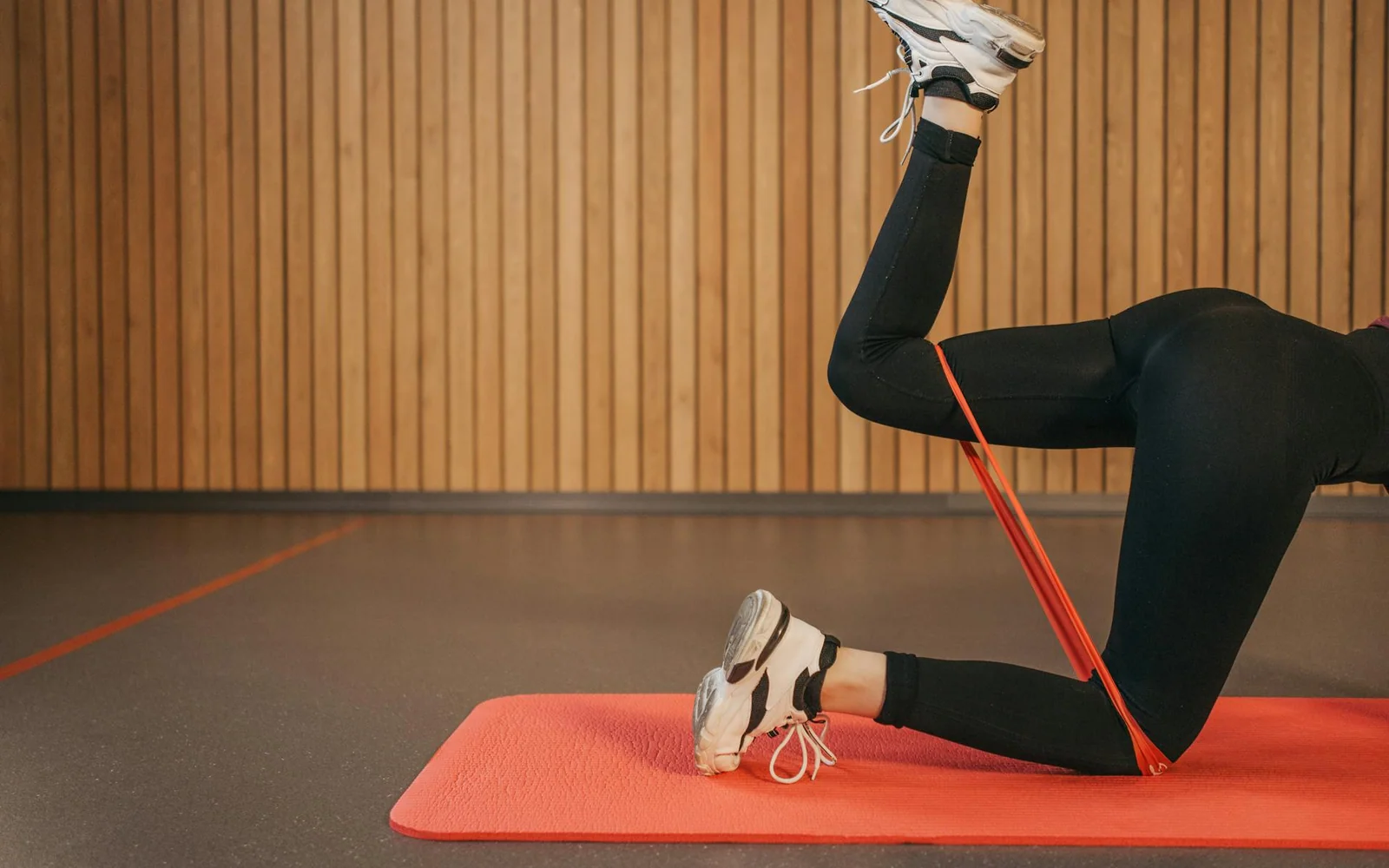
- Banded glute bridges (15 reps)
- Banded pull-aparts (15 reps)
- Bodyweight squat to reach (10 reps)
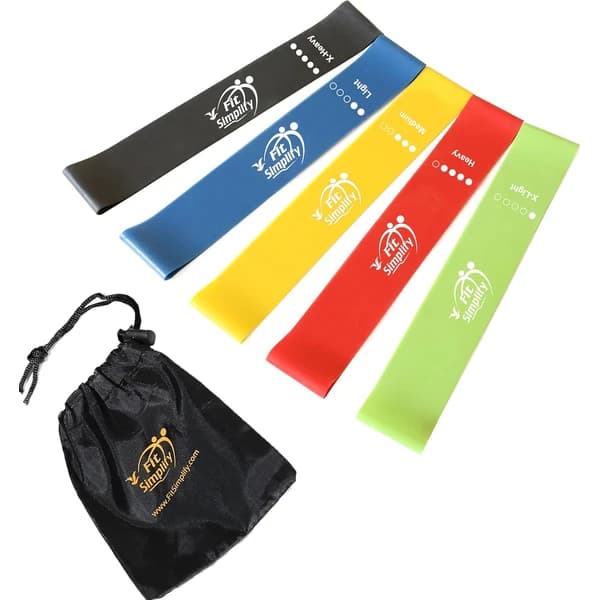
A resistance band set is the single most useful warm-up tool you can own. It activates glutes and upper back muscles that most of us sit on all day, and primes them for the main lifts. Research from the Journal of Strength and Conditioning Research suggests that dynamic warm-ups with resistance-based activation drills improve subsequent lift performance by 5–9% compared to static stretching alone.
Amazon · Affiliate
Fit Simplify Resistance Loop Bands (5-Pack)
4.7
Premium latex resistance bands for all fitness levels. Perfect for home workouts, stretching, and rehab.
$10–$15Check Price on Amazon
If you only have five minutes, spend them here — not scrolling your phone between sets.
The LBE Kettlebell Foundation Program: 5 Essential Movements
The LBE Framework — Load, Brace, Express
Every rep in this program follows the same three-phase demand: Load the hinge (pre-tension the posterior chain), Brace the core (intra-abdominal pressure), Express power through the hips. Master this sequence on the five movements below and you have a complete strength-and-conditioning foundation that scales indefinitely.
Master these five movements before adding anything else. Together they cover every major pattern the human body needs to train — no other equipment required.
Kettlebell Exercise Library
| Movement | Pattern | Primary Muscles | Beginner Variation | Sets / Reps | | --- | --- | --- | --- | --- | | Kettlebell Swing | Hip Hinge | Glutes, hamstrings, lower back | Two-handed swing | 3 × 10–20 | | Goblet Squat | Squat | Quads, glutes, core | Bell held at chest by horns | 3 × 8–12 | | Kettlebell Halo | Mobility / Core | Shoulders, thoracic spine, core | Light bell, seated if needed | 3 × 5 each direction | | Overhead Press | Vertical Push | Delts, triceps, rotator cuff | Single arm from rack position | 3 × 5–8 per side | | Bent-Over Row | Horizontal Pull | Lats, rhomboids, biceps | Brace hand on knee for support | 3 × 8–10 per side |
1. Kettlebell Swing (Hip Hinge)
The swing is the defining kettlebell movement. It's a hip-hinge, not a squat — the power comes from snapping your hips forward, not from lifting with your arms.
- Stand with feet shoulder-width apart, bell on the floor about a foot in front of you
- Hinge at the hips, grab the bell with both hands, and "hike" it back between your legs
- Explosively drive your hips forward, floating the bell to chest height
- Let gravity return the bell; re-hinge and repeat
Reps: 10–20. Stop when form breaks down, not when your arms get tired.
2. Goblet Squat (Squat Pattern)
Hold the bell by the horns at chest height, elbows tucked. Squat down until your elbows touch your thighs, chest tall, then drive through the floor to stand.
Why beginners love it: Holding the bell at your chest counterbalances your weight, which lets most people achieve better squat depth than they can with an empty barbell. It's the single best teaching tool for squat mechanics.
Reps: 8–12.
3. Kettlebell Halo (Mobility + Core)
Hold the bell by the horns at chin height. Slowly circle it around your head — hugging it close to your ears — switching direction each rep. This is a shoulder mobility drill disguised as a strength move.
Reps: 5 in each direction. Keep ribs down and glutes squeezed to stop your lower back from arching.
4. Kettlebell Press (Vertical Push)
Clean the bell to the rack position (elbow tucked, bell resting on the back of your forearm). Press straight overhead, biceps finishing beside your ear. Lower under control.
Comparison: Because of the offset load, a kettlebell press recruits roughly 20% more stabilizer activity in the shoulder than a dumbbell press of the same weight, according to EMG analysis from strength-training researcher Bret Contreras. That's why kettlebell pressing feels disproportionately hard — and why it builds such resilient shoulders.
Reps: 5–8 per side.
5. Bent-Over Row (Horizontal Pull)
Hinge forward at the hips with a neutral spine, bell in one hand. Row it toward your hip pocket — not your chest — squeezing your lat at the top. Lower slowly.
Reps: 8–10 per side.
Kettlebell Weight Selection Guide
Choosing the right starting weight is the most important purchase decision you'll make. Too light and you'll groove sloppy ballistic mechanics; too heavy and you'll compensate with your lower back.
| Goal | Women — Start Here | Men — Start Here | Notes | | --- | --- | --- | --- | | General fitness / fat loss | 8 kg (18 lb) | 16 kg (35 lb) | Most common starting point; allows clean swing mechanics | | Strength-focused | 10–12 kg (22–26 lb) | 18–20 kg (40–44 lb) | Step up once you can swing 50 reps unbroken | | Conditioning / HIIT | 6–8 kg (13–18 lb) | 12–14 kg (26–31 lb) | Lighter load, higher volume — keep form sharp | | Size up when... | Swing 50 reps easily | Swing 50 reps easily | Increase by ~4 kg increments | | Size down when... | Can't complete 20 reps | Can't complete 20 reps | Form breakdown > fatigue = wrong weight |
The 4-Week Beginner Progression
Train 3 days a week with at least one rest day between sessions (e.g., Monday / Wednesday / Friday). Each workout follows the same structure: 5-minute warm-up, main circuit, then a 3-minute cooldown walk.
Week 1 — Groove the Patterns
Circuit (3 rounds, rest 60 seconds between rounds):
- Goblet squat — 8 reps
- Kettlebell swing — 10 reps
- Halo — 5 each direction
- Press — 5 each side
- Bent-over row — 8 each side
Focus: Perfect form. Film yourself on the swing — you should see a clear hinge, not a squat.
Week 2 — Add Volume
Same circuit, 4 rounds, rest 45 seconds. Add 2 reps to swings (12) and squats (10). Total workout time stays under 30 minutes.
Week 3 — Add Density
4 rounds, rest 30 seconds. Introduce the Turkish get-up as a 6th movement (1 rep per side) if form on the basics looks clean. If not, stay on the five foundations — there is no prize for rushing.
Week 4 — Test Day
5 rounds, rest 30 seconds. Finish with a 5-minute "swing EMOM": every minute on the minute, perform 10 swings and rest the remaining time. That's 50 swings in 5 minutes — a meaningful conditioning benchmark to retest every few weeks.
After Week 4, you can either size up your bell (by roughly 4 kg) or layer on a second, heavier bell for double-bell work.
Kettlebells vs Dumbbells: Which Belongs in Your Home Gym?
This is the most common question beginners ask, and the honest answer is: both, if you can swing it — but if you have to pick one, it depends on your goals.
| Factor | Kettlebell | Dumbbell | | --- | --- | --- | | Ballistic movements (swings, snatches, cleans) | Far superior — handle geometry is built for it | Possible but awkward | | Unilateral pressing and rows | Good | Excellent | | Grip strength demand | Very high (thick handle) | Moderate | | Learning curve | Steeper | Gentler | | Floor space needed | 4 sq ft | 4 sq ft | | Cost per pound | Higher | Lower | | Scalability | Need multiple bells | One adjustable pair covers a huge range |
For pure conditioning and posterior-chain work, the kettlebell wins. For the widest range of accessible lifts — chest press, incline press, bicep curls, lateral raises, walking lunges — adjustable dumbbells are more flexible and far cheaper per pound of usable load. Serious home lifters usually end up with both; the smartest order of operations for most beginners is to buy one well-sized kettlebell first, train with it for 8–12 weeks, then add a pair of adjustable dumbbells to broaden the library of exercises you can do.
Don't Neglect Recovery: The Role of Soft-Tissue Work
Ballistic kettlebell training accumulates tension in the hips, hamstrings, and thoracic spine faster than most people expect. Three days a week of swings and presses will leave these areas feeling locked up if you don't address tissue quality between sessions.
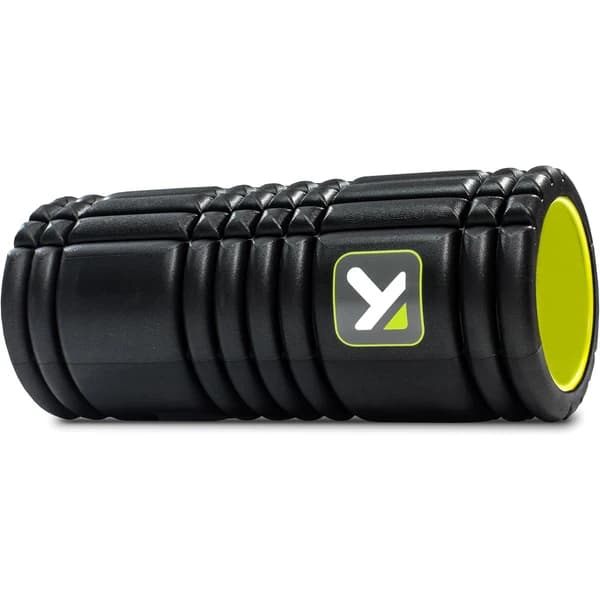
A foam roller targets the exact areas that kettlebell training loads hardest: glutes, hamstrings, lats, and upper back. Spend 5–10 minutes rolling these areas on your rest days, and you'll recover faster, move better on your next session, and reduce the odds of the low-level tightness that turns into actual injury over a training month.
Amazon · Affiliate
TriggerPoint GRID Foam Roller
4.7
Multi-density foam roller for muscle recovery and myofascial release. Used by pro athletes.
$30–$40Check Price on Amazon
Simple rest-day protocol: 60 seconds per side on glutes and hamstrings, 60 seconds on each lat, 90 seconds rolling up the thoracic spine. That's under 10 minutes and makes a measurable difference in how you feel on your next training day.
Common Beginner Mistakes to Avoid
- Squatting the swing. The swing is a hinge. Your shins should stay vertical — if your knees shoot forward, you're squatting.
- Letting the bell flop at lockout. On presses, the bell should sit quietly on the back of your forearm. If it's banging your wrist, your grip is too loose or your press path is too far from your body.
- Training every day. Ballistic kettlebell work is neurologically demanding. Three days a week is plenty for beginners.
- Ignoring the core. Between every set, stand tall, squeeze your glutes, and brace your abs for 5 seconds. This primes bracing patterns that will protect your back on heavier days.
- Going too heavy too fast. Respect the bell. A 24 kg bell swung with a broken hinge is a back injury waiting to happen; the same weight swung with clean mechanics is one of the best conditioning tools in existence.
Final Thoughts
A kettlebell workout for beginners doesn't need to be complicated. The LBE Kettlebell Foundation Program gives you five movements, four weeks, and one bell — that's enough to build a foundation that will serve you for years. The real magic isn't the tool; it's the consistency. Most people who quit home training quit because they overcomplicated things in week two. Keep it simple, film your form, and let the reps accumulate.
The equipment list is equally short: one well-sized bell, a resistance band for warm-ups, and a foam roller for recovery days. Three items, no gym required.
When you're ready to layer in complementary work, pair this plan with our Home Workout Guide for Beginners or dig into our Compound vs Isolation Exercises breakdown to understand how kettlebell lifts fit into a broader strength framework.
One bell. Four weeks. Show up.
Affiliate disclosure: Some links in this article are affiliate links. If you purchase through them, we may earn a small commission at no extra cost to you. We only recommend products we genuinely believe in.
About the author
Nathan reviews the research, tests the tools, and writes the guides at LeanBodyEngine — evidence-first, no sponsored content, no supplement shilling.
Related articles
Subscribe
Never miss a new article
Get an email whenever we publish a new fitness guide, supplement review, or workout plan. One short email per post — that's it.
Unsubscribe anytime. We only email when there's a new post.