Resistance Band Workout: 12 Exercises for Full-Body Strength at Home
A complete resistance band workout — 12 exercises covering push, pull, legs, and core, scaling from absolute beginner to intermediate load.
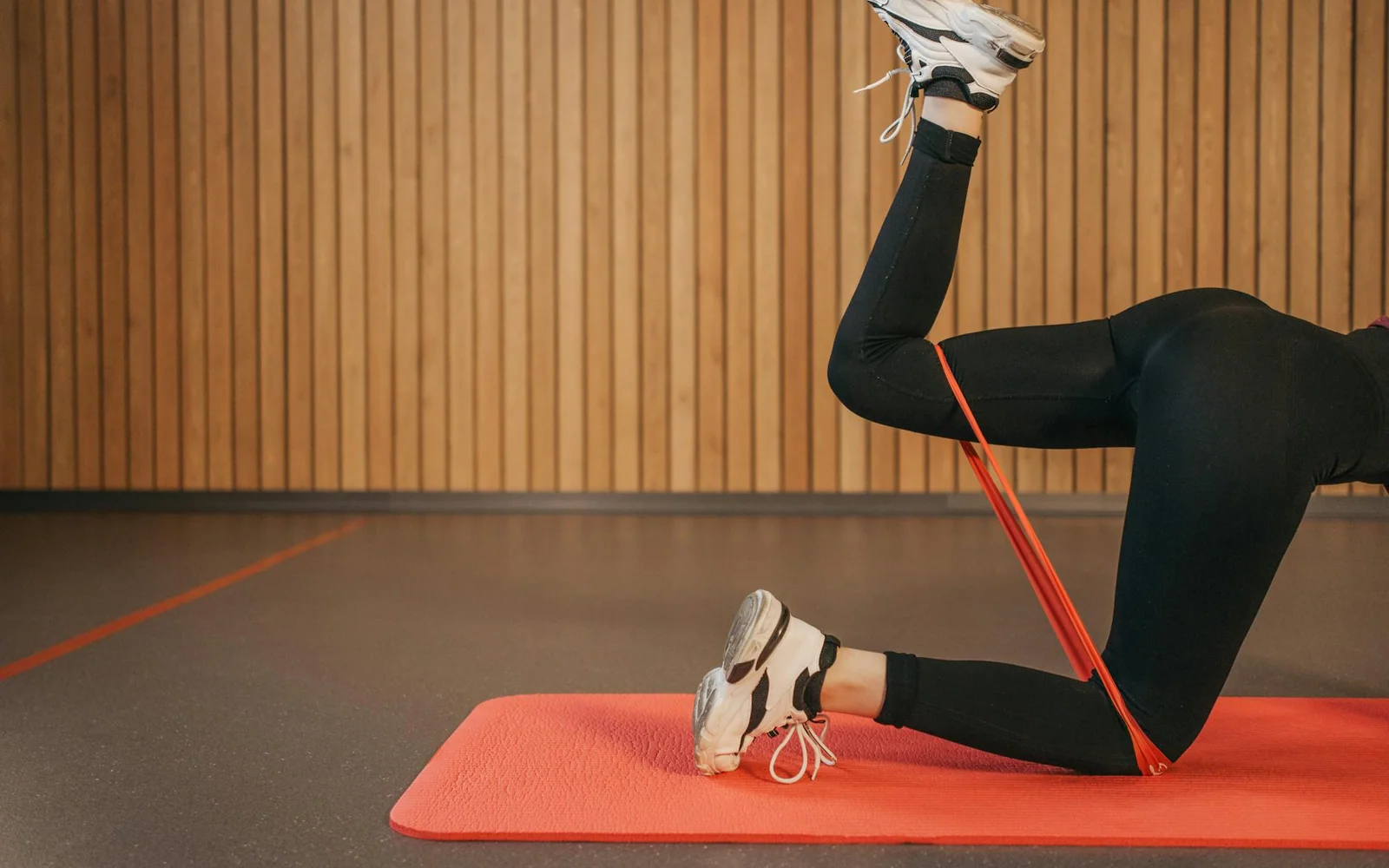
A well-designed resistance band workout gives you almost everything a rack of dumbbells can, at a fraction of the cost and space. Bands are quiet, portable, easy on the joints, and — as the research below shows — surprisingly effective at building real strength. This guide walks beginners through 12 exercises covering push, pull, legs, and core, along with a simple weekly split you can start using today.
Key Takeaways
- A 2019 systematic review in SAGE Open Medicine found elastic resistance training produces strength and hypertrophy outcomes comparable to conventional weight training when matched for effort and volume.
- EMG studies show band exercises elicit muscle activation levels similar to free-weight equivalents — including no meaningful difference in chest activation between barbell and band pressing.
- Bands provide ascending resistance: tension increases throughout the range of motion, loading the muscle hardest at its strongest joint angle — the opposite of gravity-based weights.
- Light bands typically provide 5–15 lbs of resistance; medium bands 15–35 lbs; heavy bands 35–65 lbs. Matching tension level to exercise and strength is critical for adequate stimulus.
- For hypertrophy, band training responds well to slightly higher rep ranges (12–20) than free weights, since peak tension occurs at full extension rather than mid-range.
- A complete band set covering light through heavy tension costs under $30 and replaces hundreds of dollars' worth of dumbbells for home training.
Why Resistance Bands Actually Work
For a long time, bands had a reputation as a "rehab tool" rather than a real strength-building option. The evidence has quietly flipped that story. A 2019 systematic review published in SAGE Open Medicine analyzed elastic resistance training across multiple populations and concluded that band-based programs produced strength and hypertrophy outcomes comparable to conventional weight-training when matched for effort and volume.
The mechanism behind this is straightforward. Electromyography (EMG) studies — which measure how hard a muscle is actually firing — have repeatedly found that well-programmed band exercises elicit muscle activation levels similar to free-weight equivalents. A commonly cited 2010 study in the Journal of Strength and Conditioning Research compared EMG output during barbell, dumbbell, and elastic-resistance bench pressing and found no meaningful difference in prime-mover activation between the modalities.
There is one important nuance. Bands provide ascending resistance: they get harder the more you stretch them. That means the top of every rep is the hardest part, which is the opposite of free weights where gravity lightens the load as you lock out. For beginners, this is actually an advantage. The hardest portion of the rep lines up with the strongest joint angle, so you can push closer to failure without wrecking your shoulders or lower back.
Combine that with portability, near-zero injury risk, and a total investment under $30, and the case for bands is clear — especially if you train at home.
Equipment You Will Need
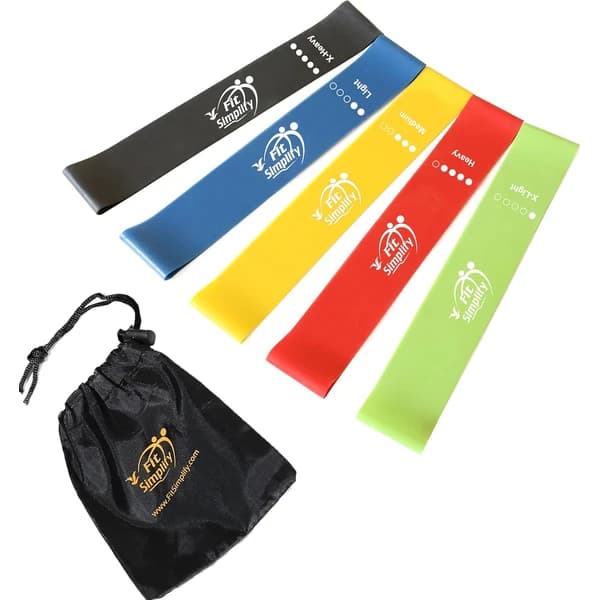
You do not need much. A set of looped bands with multiple resistance levels will cover every exercise in this guide. Look for a set that includes at least three tension levels (light, medium, heavy) plus a door anchor and handles. That combination lets you load pushes, pulls, squats, and core work without running out of resistance as you progress.
Amazon · Affiliate
Fit Simplify Resistance Loop Bands (5-Pack)
4.7
Premium latex resistance bands for all fitness levels. Perfect for home workouts, stretching, and rehab.
$10–$15Check Price on Amazon
Optional but useful add-ons: a doorway pull-up bar for the assisted pull-up variation below, and a foam roller for recovery work at the end of each session. Everything else — floor space, a towel, shoes — you probably already have.
Band Resistance Quick-Reference Guide
Choosing the right tension level matters as much as choosing the right exercise. Too light and you won't create enough stimulus; too heavy and form breaks down. Use this table as your starting point — adjust one level up or down based on how the final two reps of each set feel.
| Color (Typical) | Resistance (lbs) | Best For | |---|---|---| | Yellow / Tan | 5–15 lbs | Warm-ups, face pulls, band pull-aparts, rehab movements | | Red / Light | 15–25 lbs | Overhead press, triceps pushdown, lateral walks, dead bug | | Green / Medium | 25–40 lbs | Chest press, seated row, push-up with band, Pallof press | | Blue / Heavy | 40–65 lbs | Band squat, glute bridge, assisted pull-up support | | Black / Extra Heavy | 65–100 lbs | Advanced squats, deadlift variations, heavy pull-downs |
The 12 Exercises
The plan groups exercises by movement pattern: four pushes, three pulls, three leg movements, and two core stabilizers. Work through them in the order listed within a session, or pick 6–8 per workout using the weekly split further down.
Exercise Reference Table
| Exercise | Band Level | Primary Muscles | Sets × Reps | |---|---|---|---| | Band Chest Press | Medium–Heavy | Chest, front delts, triceps | 3 × 10–12 | | Overhead Press | Light–Medium | Shoulders, triceps, upper traps | 3 × 8–10 | | Push-Up with Band | Medium | Chest, triceps, anterior delts | 3 × 8–12 | | Triceps Pushdown | Light–Medium | Triceps (all three heads) | 3 × 12–15 | | Seated Row | Medium–Heavy | Mid-back, biceps, rear delts | 3 × 10–12 | | Face Pull | Light–Medium | Rear delts, mid-traps, rotator cuff | 3 × 15 | | Band Pull-Apart | Light | Rear delts, mid-traps, rhomboids | 3 × 15–20 | | Band Squat | Heavy | Quads, glutes, hamstrings | 3 × 10–15 | | Glute Bridge with Band | Medium | Glutes, glute medius, hamstrings | 3 × 12–15 | | Lateral Walk | Light–Medium | Glute medius, TFL, hip abductors | 3 × 10 steps/side | | Pallof Press | Medium | Obliques, transverse abdominis, lats | 3 × 10/side | | Dead Bug with Band | Light–Medium | Deep core, lats, hip flexors | 3 × 8/side |
Push (4 Exercises)
1. Band Chest Press
Anchor the band behind you at chest height, face away, and press both handles forward until your arms are fully extended. Keep your ribs tucked and your shoulder blades lightly retracted so the chest does the work, not the front of the shoulders.
Reps: 3 sets of 10–12
2. Overhead Press
Stand on the band with both feet, hold a handle in each hand at shoulder height, and press straight up. Keep your core braced and ribs down — no leaning back to cheat the weight up.
Reps: 3 sets of 8–10
3. Push-Up with Band
Loop a band across your upper back and hold the ends under each palm. Perform a standard push-up. The band adds tension at lockout, turning an easy bodyweight move into a real chest builder.
Reps: 3 sets of 8–12
4. Triceps Pushdown
Anchor the band at the top of a door. Grab both handles with elbows pinned at your sides and push down until your arms are straight. Slow the way back up — that eccentric phase is where triceps growth happens.
Reps: 3 sets of 12–15
Pull (3 Exercises)
Pulling exercises are where home lifters usually fall short. Bands fix this because you can anchor them anywhere and pull in any direction.
5. Seated Row
Sit on the floor, loop the band around your feet, and pull the handles toward your ribs. Drive your elbows back, squeeze your shoulder blades together, and resist the return. If you have space, a seated row is the single best way to undo hours of hunched desk posture.
Reps: 3 sets of 10–12
6. Face Pull
Anchor the band at face height. Pull the handles toward your forehead with elbows high and wide, rotating your hands so your thumbs point behind you at the end of the rep. This hits the rear delts and mid-traps — underused muscles that keep your shoulders healthy.
Reps: 3 sets of 15
7. Band Pull-Apart
Hold the band in both hands at chest height, arms straight, and pull outward until your arms form a T. A simple move that pays huge dividends for posture and shoulder health.
Reps: 3 sets of 15–20
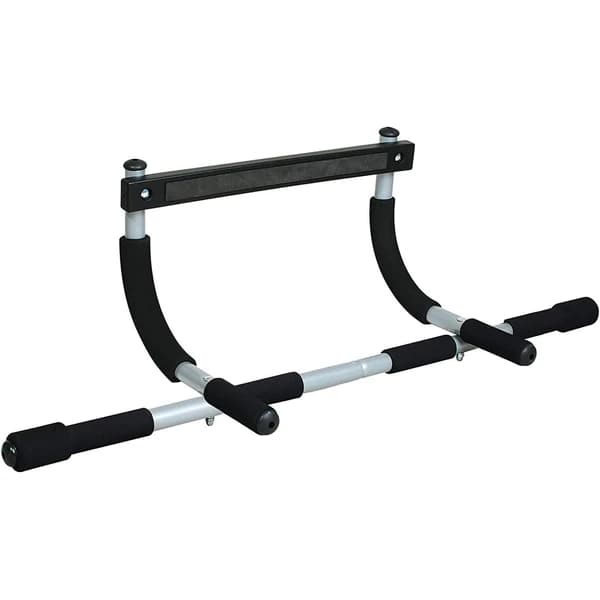
Assisted pull-up variation: If you have access to a doorway bar, loop a heavy band over the bar and place one foot or knee inside. The band unloads part of your bodyweight at the bottom of the rep where pull-ups are hardest, then tapers off as you reach the top. It is the most effective way to progress from zero pull-ups to your first unassisted rep.
Amazon · Affiliate
Iron Gym Total Upper Body Workout Bar
4.5
Doorframe pull-up bar with no screws required. Supports up to 300 lbs. Doubles as a dip station.
$25–$35Check Price on Amazon
Legs (3 Exercises)
8. Band Squat
Stand on the band with both feet, bring the handles up to your shoulders, and squat down to parallel. The band resists you hardest as you stand up — right where the squat is weakest for most people.
Reps: 3 sets of 10–15
9. Glute Bridge with Band
Lie on your back with a looped band just above your knees. Drive your hips up while actively pushing your knees outward against the band. The added abduction component wakes up the glute medius, which tends to sleep through normal bridges.
Reps: 3 sets of 12–15
10. Lateral Walk
Place a loop band around your ankles or just above the knees. Bend into a quarter-squat and step sideways for 10–15 steps, then reverse. Keep constant tension on the band — no slack between steps.
Reps: 3 sets of 10 steps each direction
Core (2 Exercises)
11. Pallof Press
Anchor the band at chest height off to your side. Stand perpendicular, hold the handle with both hands at your sternum, and press straight out. The band will try to rotate you — your job is to resist. This is anti-rotation training, and it is one of the most underrated ways to build a genuinely strong midsection.
Reps: 3 sets of 10 per side
12. Dead Bug with Band
Anchor the band behind your head. Lie on your back, grab the band with both hands, and press your arms toward the ceiling. From there, extend one leg out while keeping your lower back pinned to the floor. The band forces your lats and core to fire together — exactly what you want for spine stability.
Reps: 3 sets of 8 per side
The LBE Full-Body Band Circuit
Once you have a few weeks of the individual exercises under your belt, this structured circuit puts all 12 together into a single efficient session. "LBE" stands for Lower–Back–Extension, the three-phase structure that ensures every major movement pattern is hit without overlap or fatigue stacking.
Format: 3 rounds. Rest 45 seconds between exercises, 90 seconds between rounds. Total time: approximately 40–45 minutes.
Phase 1 — Lower Body (4 exercises)
- Band Squat — 12 reps
- Glute Bridge with Band — 15 reps
- Lateral Walk — 10 steps each direction
- Dead Bug with Band — 8 reps per side
Phase 2 — Back and Pull (4 exercises) 5. Seated Row — 12 reps 6. Face Pull — 15 reps 7. Band Pull-Apart — 20 reps 8. Assisted Pull-Up (or extra set of Seated Row) — 6–10 reps
Phase 3 — Extension and Press (4 exercises) 9. Band Chest Press — 10 reps 10. Overhead Press — 10 reps 11. Push-Up with Band — 10 reps 12. Pallof Press — 10 reps per side
Progression rule: Complete all 3 rounds with the prescribed reps before moving up a band tension level. Do not add weight and volume at the same time. When you can hit the top of every rep range comfortably across all 3 rounds, increase tension on that exercise only.
Recovery Matters More Than You Think
Progress does not happen during the workout — it happens between workouts, when your body repairs the muscle fibers you stressed and rebuilds them slightly stronger. Undercook that recovery and you plateau. Overcook the sessions and you get hurt.
Three habits handle most of it: sleep 7–9 hours, eat enough protein (roughly 0.7–1.0 grams per pound of bodyweight), and spend 5–10 minutes after each workout on soft-tissue work. Rolling the quads, hamstrings, lats, and upper back reduces next-day soreness and keeps your movement quality high session after session.
A Sample 3-Day Weekly Split
Three sessions per week is plenty for a beginner and leaves enough recovery between workouts. Train on non-consecutive days — something like Monday, Wednesday, Friday.
Day 1 — Push + Core
- Band chest press: 3 × 10–12
- Overhead press: 3 × 8–10
- Push-up with band: 3 × 8–12
- Triceps pushdown: 3 × 12–15
- Pallof press: 3 × 10 per side
Day 2 — Pull + Legs
- Seated row: 3 × 10–12
- Face pull: 3 × 15
- Band pull-apart: 3 × 15–20
- Band squat: 3 × 10–15
- Lateral walk: 3 × 10 per direction
Day 3 — Full Body
- Assisted pull-up (or seated row): 3 × 6–10
- Band chest press: 3 × 10
- Glute bridge with band: 3 × 12–15
- Overhead press: 3 × 8
- Dead bug with band: 3 × 8 per side
Start with the lightest band that still makes the final 2–3 reps of each set genuinely difficult. When a set feels easy, move up a tension level or add a rep per set until you hit the top of the rep range, then progress. That simple rule — do slightly more than last week — is the entire secret to progressive overload with bands.
Final Thoughts
A resistance band workout is not a compromise. It is a legitimate, research-backed way to build strength, improve posture, and train every major muscle group from home with almost no space and almost no budget. The 12 exercises above cover every meaningful movement pattern — push, pull, hinge, squat, and anti-rotation core — which is more than most gym-goers hit in a standard session.
Start with the individual exercises, move into the 3-day split, and graduate to the LBE Full-Body Band Circuit when you want to compress your training into a single dense session. Stick with any of those structures for 6–8 weeks and you will surprise yourself with how much stronger you feel.
If you do not already have a band set, grab one that covers light through heavy tension so you can keep progressing past the beginner phase. Your future self — and your joints — will thank you.
Amazon · Affiliate
Fit Simplify Resistance Loop Bands (5-Pack)
4.7
Premium latex resistance bands for all fitness levels. Perfect for home workouts, stretching, and rehab.
$10–$15Check Price on Amazon
Affiliate disclosure: Some links in this article are affiliate links. If you purchase through them, we may earn a small commission at no extra cost to you. We only recommend products we genuinely believe in.
About the author
Nathan reviews the research, tests the tools, and writes the guides at LeanBodyEngine — evidence-first, no sponsored content, no supplement shilling.
Related articles
Subscribe
Never miss a new article
Get an email whenever we publish a new fitness guide, supplement review, or workout plan. One short email per post — that's it.
Unsubscribe anytime. We only email when there's a new post.