Pull-Up Progression for Absolute Beginners: From Zero to 10 in 8 Weeks
Go from zero pull-ups to 10 reps in 8 weeks with this step-by-step progression plan, form guide, and budget equipment recommendations.
The pull-up is the ultimate test of relative strength. It asks a simple question: can you lift your own bodyweight? For most adults, the honest answer is no — not even one. Research from the U.S. Army's fitness standards consistently shows that a large majority of untrained adults cannot perform a single clean pull-up. That's not embarrassing. It's just a starting point.
The good news: the pull-up is also one of the most trainable movements in existence. With a structured eight-week progression, the right equipment, and a handful of supplementary exercises, most beginners can go from zero reps to ten — and the strength you build along the way transfers to nearly every upper-body goal you'll ever have.
This guide walks you through exactly how to get there.
Key Takeaways
- The dead hang is the foundation — if you can't hang for 30 seconds, start there.
- The five-step progression (dead hang → scapular pulls → negatives → banded pull-ups → full pull-ups) is the fastest path for beginners.
- You need only one piece of equipment: a doorframe pull-up bar under $35.
- Resistance bands cut the cost of an assisted pull-up machine to near zero.
- Core strength directly limits pull-up performance — don't skip it.
- Eight weeks of consistent training (three sessions per week) is enough for most beginners to reach their first set of 10.
Why Pull-Ups Are Worth Mastering
Pull-ups build the back, biceps, forearms, and core simultaneously. No machine — not the lat pulldown, not the cable row — replicates the full-body demand of lifting your own weight through a complete range of motion. Here's why that matters:
Relative strength is more practical than absolute strength. A person who can pull up their own bodyweight ten times can climb, carry, and move in the real world. A person with a high lat pulldown number has gym-specific strength that doesn't always transfer.
Pull-ups build the V-taper. The latissimus dorsi — the large fan-shaped muscle spanning your mid-back — is the primary mover in a pull-up. Developing it creates the shoulder-to-waist ratio that most people associate with a fit physique, regardless of gender.
They're a reliable performance benchmark. The military, police departments, fire academies, and climbing gyms all use pull-ups as a baseline fitness test. Reaching ten consecutive reps puts you solidly in the top tier of general fitness.
The skill compounds. Once you can do ten pull-ups, progressing to weighted pull-ups, muscle-ups, or one-arm variations becomes achievable. The foundation opens the next level.
Prerequisites: The Dead Hang Strength Test
Before you attempt a single pull-up, you need to assess your starting point. The dead hang test tells you whether you have the grip, shoulder, and upper-back endurance to begin the progression safely.
How to perform the dead hang test:
- Grip the bar with both hands, shoulder-width apart, palms facing away (pronated grip).
- Let your body hang completely — arms fully extended, feet off the floor.
- Engage your core slightly to prevent excessive swinging.
- Hold for as long as possible without jumping or kipping.
What your result means:
| Dead Hang Duration | What It Means | |---|---| | Under 15 seconds | Start with grip training and dead hangs only for Week 1 | | 15–30 seconds | Begin the full progression at Step 1 | | 30–60 seconds | You're ready for scapular pulls immediately | | 60+ seconds | Skip to Step 3 (negatives) |
If you can't hang for 15 seconds, don't skip ahead — grip and shoulder girdle weakness will stall you at every subsequent step. Spend the first week building to a 30-second hang before advancing.
The 5-Step Pull-Up Progression
Each step below prepares your body for the next. Don't rush — spending an extra session on a step costs you a few days; skipping a step and getting injured costs you weeks.
Step 1: Dead Hang
Goal: 3 × 30 seconds
The dead hang builds the grip, wrist, and shoulder stability required for all subsequent steps. It also decompresses the spine and teaches you to engage your shoulder blades passively — a critical skill for safe pull-up mechanics.
Form cues:
- Grip slightly wider than shoulder-width.
- Arms fully extended — no bent elbows.
- Shoulders packed down and back (avoid shrugging into your ears).
- Breathe normally. Bracing your core lightly will reduce swinging.
- Feet can touch the floor for bail-outs — this isn't cheating, it's safety.
Progression trigger: Move to Step 2 when you can hold three sets of 30 seconds with two minutes of rest between sets.
Step 2: Scapular Pull-Ups
Goal: 3 × 8–10 reps
A scapular pull-up is the smallest possible pulling movement: hanging from the bar, you depress and retract your shoulder blades without bending your elbows. Your body rises only an inch or two. This trains the lower trapezius and serratus anterior — muscles that protect the shoulder and initiate every pull-up.
Form cues:
- Start in a dead hang.
- Without bending your elbows, squeeze your shoulder blades together and downward.
- Think "pull shoulders away from ears."
- Hold the top position for one second, then slowly return to a dead hang.
- No swinging, no kipping.
Why this matters: Most beginners who fail their first pull-up aren't limited by bicep strength — they lack scapular control. Skipping this step leads to the "shrugging" pull-up, which is a shoulder injury waiting to happen.
Progression trigger: Move to Step 3 when you can perform 3 × 10 reps with controlled form.
Step 3: Negative Pull-Ups (Eccentric-Only)
Goal: 3 × 5–8 reps with a 3–5 second lowering phase
Eccentric (lowering) training produces significantly more muscle damage and strength adaptation than concentric (lifting) training, which is why negatives are the fastest path to a first pull-up. Your muscles can resist about 30–40% more force than they can generate — meaning you can control a lowering phase long before you can pull yourself up.
How to perform a negative pull-up:
- Stand on a chair or box to get your chin above the bar.
- Grip the bar at shoulder-width, palms facing away.
- Jump or step your chin over the bar, then slowly lower yourself over 3–5 seconds until your arms are fully extended.
- Step back up and repeat.
Form cues:
- The lowering phase should be controlled, not a drop.
- Keep your core braced throughout.
- Full range of motion — stop when arms are fully extended, not before.
- If you can't control the descent (dropping in under 2 seconds), reduce reps and focus on quality.
Progression trigger: Move to Step 4 when you can perform 3 × 8 negatives with a 4-second lowering phase.
Step 4: Banded Pull-Ups
Goal: 3 × 8–10 reps with the lightest band that allows full range of motion
Resistance bands loop around the bar and under your feet or knees, providing ascending assistance — meaning they help most at the bottom of the movement (where you're weakest) and least at the top (where you're strongest). This mirrors the strength curve of the pull-up better than any machine.
How to set up banded pull-ups:
- Loop a resistance band over the pull-up bar and thread one end through the other to secure it.
- Place one or both feet (or knees) in the hanging loop.
- Perform pull-ups with full range of motion — chin over bar at the top, arms fully extended at the bottom.
Band progression: Start with the thickest band in your set. As reps become easy (3 × 10 without struggling), drop to the next thinner band. The goal is to eventually need no band at all.
Form cues:
- Same form as a full pull-up — no kipping or swinging.
- Keep elbows pulling down and back, not flaring out.
- Pause briefly at the top with chin over bar.
Amazon · Affiliate
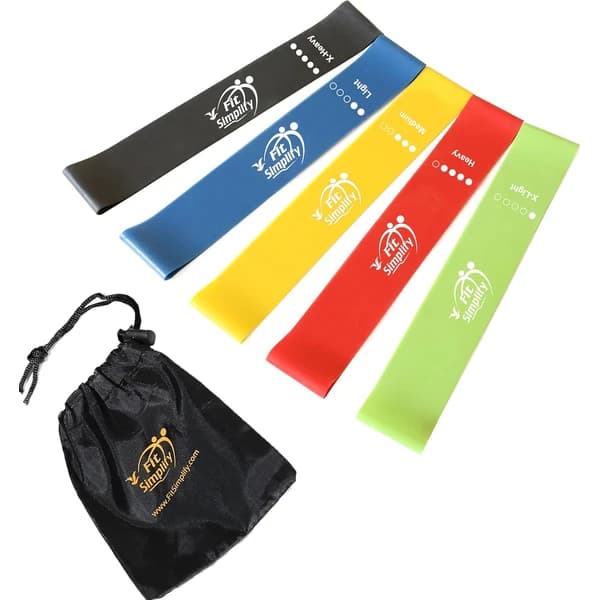
Fit Simplify Resistance Loop Bands (5-Pack)
4.7
Premium latex resistance bands for all fitness levels. Perfect for home workouts, stretching, and rehab.
$10–$15Check Price on Amazon
The Fit Simplify Resistance Loop Bands (5-pack) are the gold standard budget tool for this step. Rated 4.7 stars across tens of thousands of Amazon reviews, the set includes five resistance levels — giving you a complete progression from heavy assistance to near-bodyweight pull-ups for under $15. Pair them with a doorframe pull-up bar and you have everything you need to reach your first unassisted rep.
Progression trigger: Move to Step 5 when you can perform 3 × 10 banded pull-ups with the thinnest band.
Step 5: Full Pull-Ups
Goal: Build from 1 rep to 3 × 10 over 2–4 weeks
Full pull-up form breakdown:
Grip width: Hands just outside shoulder-width. Too narrow (close grip) shifts emphasis to biceps; too wide (wide grip) limits range of motion and stresses the shoulder joint. Shoulder-width pronated (palms away) is the standard starting position.
Shoulder engagement: Before initiating the pull, depress and retract your scapulae (as in Step 2). This "packs" the shoulder joint and reduces impingement risk. Think: shoulders down and back, not up and shrugging.
Dead hang starting position: Every rep begins with arms fully extended. Partial range-of-motion pull-ups (starting with elbows slightly bent) are harder to count and don't train the full muscle through its range. Full extension also protects the bicep tendon under load.
The pull: Drive your elbows toward your hips — not directly down, but slightly back. Visualize pulling the bar to your chest rather than pulling your body to the bar. This mental cue activates the lats more effectively than thinking "pull with your arms."
The top: Chin clearly over the bar. Nose-to-bar doesn't count for most standards, and stopping short limits lat activation at the peak contraction.
The descent: Lower with control — aim for 2 seconds down. No dropping from the top position.
The 8-Week Plan
Three sessions per week. Rest at least one day between sessions. Each session takes 20–30 minutes.
| Week | Session Focus | Sets × Reps | Step | |---|---|---|---| | 1 | Dead hang & grip conditioning | 5 × max hang (goal: 30 sec) | Step 1 | | 2 | Scapular pull-ups | 3 × 8–10 scapular pulls + 3 × 30 sec hang | Step 2 | | 3 | Negatives introduction | 3 × 5 negatives (3-sec lowering) + 3 × 10 scapular pulls | Step 3 | | 4 | Negatives intensification | 4 × 6 negatives (4-sec lowering) | Step 3 | | 5 | Banded pull-ups (thick band) | 3 × 8–10 banded + 2 × 5 negatives | Step 4 | | 6 | Banded pull-ups (medium band) | 3 × 10 banded + attempt 1–2 unassisted | Steps 4–5 | | 7 | First unassisted reps + banded sets | Max effort unassisted × 3 sets; fill with banded sets | Step 5 | | 8 | Build to 3 × 10 unassisted | Pyramid: 3–5–7–5–3 or straight sets to failure | Step 5 |
Notes on the plan:
- "Max effort" in Week 7 means stopping one rep short of failure. Training to failure every session delays recovery and stalls progress.
- If you're still at Step 3 in Week 6, stay there. This is a guideline, not a contract.
- Rest periods: 2–3 minutes between pulling sets. Pull-up strength is a neuromuscular skill — rest is not laziness, it's part of the training.
- Add a deload (reduce volume by 40–50%) every fourth week if cumulative fatigue builds.
Equipment You Need
You don't need a gym. You need a bar and about $50.
The Budget Route (~$65 total)
Step 1: A pull-up bar. A doorframe pull-up bar requires no installation, no screws, and no landlord permission. It mounts and dismounts in seconds. For most beginners, this is all the hardware you'll ever need.
Amazon · Affiliate
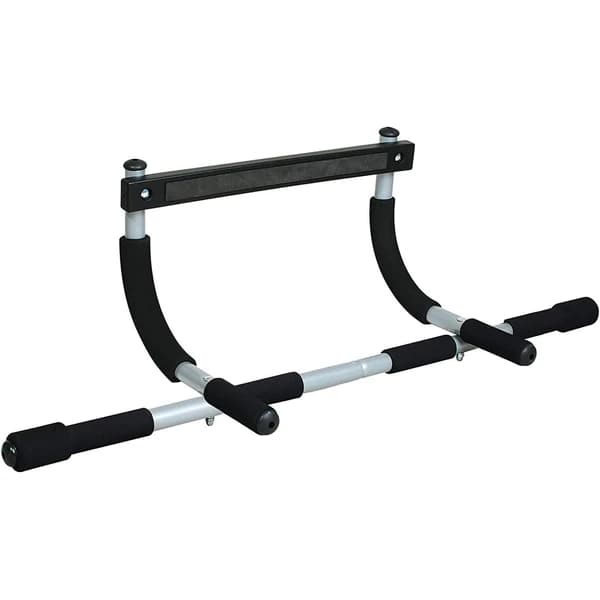
Iron Gym Total Upper Body Workout Bar
4.5
Doorframe pull-up bar with no screws required. Supports up to 300 lbs. Doubles as a dip station.
$25–$35Check Price on Amazon
The Iron Gym Total Upper Body Workout Bar supports up to 300 lbs, doubles as a dip station when placed on the floor, and costs $25–$35. With 4.5 stars and thousands of verified reviews, it's the most recommended doorframe bar on the market. No tools required — it braces against the door frame using your bodyweight.
Step 2: Resistance bands. You already saw these in Step 4 of the progression. At $10–$15 for a five-pack, the Fit Simplify bands eliminate the need for an assisted pull-up machine costing hundreds of dollars.
Budget Route Total: ~$50–$65 — everything you need from Week 1 through Week 8 and beyond.
The Full Home Gym Route (~$400+)
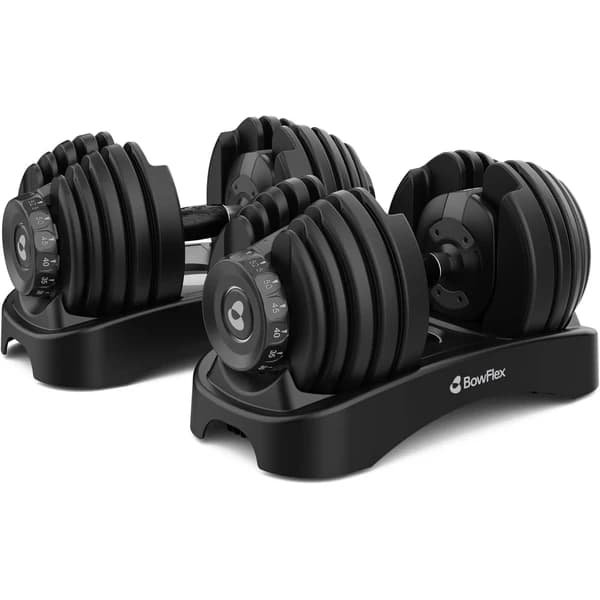
If you're building a home gym and want supplementary equipment for the rowing and pulling exercises below, adjustable dumbbells are the single highest-value purchase you can make.
Amazon · Affiliate
Bowflex SelectTech 552 Adjustable Dumbbells
4.8
Replace 15 sets of weights. Dial adjusts from 5 to 52.5 lbs. Space-saving design for home gyms.
$300–$400Check Price on Amazon
The Bowflex SelectTech 552 replaces 15 separate dumbbell pairs, adjusting from 5 to 52.5 lbs with a twist of the dial. Rated 4.8 stars with thousands of reviews, it's the benchmark product in adjustable dumbbells. The $300–$400 investment is significant, but the per-exercise cost over its lifetime is lower than any gym membership. For the pull-up program, you'll use it for bent-over rows, single-arm rows, and dumbbell lat pullovers — all of which directly support pull-up strength.
Supplementary Exercises
Pull-up strength doesn't come only from pull-ups. These four exercises accelerate the program by addressing the specific muscular weaknesses that limit beginners.
Bent-Over Dumbbell Row
Why: Rows strengthen the rhomboids, middle trapezius, and posterior deltoids — muscles that support scapular retraction in every pull-up rep.
How: Hinge at the hips to a 45-degree angle, back flat, dumbbells hanging. Row them to your lower ribs, leading with the elbows. Pause at the top, lower with control. 3 × 10–12 reps.
Inverted Row (Australian Pull-Up)
Why: An easier horizontal pulling movement that builds the same muscles as a pull-up without the full bodyweight challenge. Perfect for Week 1–3 supplemental work.
How: Set up a bar at hip height (a kitchen counter or a low barbell across two chairs works). Lie underneath, grip the bar, and pull your chest to it while keeping your body straight. Lower slowly. 3 × 8–15 reps.
Band Pull-Apart
Why: Directly trains the rear deltoids and scapular retractors. A common weakness that causes the elbows to flare during pull-ups, which reduces power and stresses the shoulder.
How: Hold a resistance band at arm's length in front of you. Pull it apart horizontally until it touches your chest, squeezing the shoulder blades together. Controlled return. 3 × 15–20 reps.
Hollow Body Hold
Why: Pull-ups require core stability to prevent your legs from swinging and to transfer force from the arms into the trunk. The hollow body is the foundational core position.
How: Lie on your back, press your lower back into the floor, raise your legs to 45 degrees and arms overhead. Hold the position while breathing. Start with 3 × 15 seconds, build to 30 seconds.
Ab Roller Roll-Out
Why: The ab roller trains anti-extension core strength — exactly what stabilizes your spine during the bottom portion of a pull-up when your body naturally wants to arch. Stronger core = less energy wasted = more reps.

Amazon · Affiliate
Perfect Fitness Ab Carver Pro
4.5
Carbon steel spring provides resistance on the way out and assists on the way back. Works abs, obliques, and arms simultaneously.
$25–$40Check Price on Amazon
The Perfect Fitness Ab Carver Pro uses a carbon steel spring that resists the roll-out and assists on the return. Unlike basic ab wheels, the spring mechanism protects your lower back by preventing uncontrolled collapse. Rated 4.5 stars, $25–$40. Do 3 sets of 6–10 roll-outs, starting from your knees. As these become easy, extend the range until you can roll from standing.
How the ab roller integrates with the pull-up program: Add 2–3 sets of ab roller roll-outs to each training session after your pull-up work. Within three weeks, you'll notice that your body swings less during dead hangs and your bottom-of-pull-up position feels more stable.
Common Mistakes
Using momentum to "kip" through reps
Kipping pull-ups — swinging the hips to use momentum — are a CrossFit skill that serves a specific competitive purpose. For a beginner building baseline strength, they're counterproductive. They reduce time under tension, shift load away from the target muscles, and teach a movement pattern that doesn't transfer to strict pull-up strength. Do strict reps only.
Stopping short at the top
Chin-to-bar (or chin barely over) feels like a pull-up but doesn't fully contract the lats at peak range. If you're consistently stopping short, it usually means you're fatiguing too early — reduce reps and focus on quality rather than volume.
Skipping the descent
Dropping from the top position after each rep eliminates the eccentric phase, which is responsible for a large portion of the strength and hypertrophy stimulus. Slow down the lowering phase. Your progress will roughly double.
Letting shoulders shrug up
When the shoulders shrug toward the ears at the start of a pull-up, it means the scapular stabilizers (lower traps) aren't activating first. This is exactly what Step 2 of the progression trains. If you're in Week 5 and still shrugging, go back and repeat the scapular pull-up work.
Training to failure every session
Beginners often equate effort with progress. In pull-up training, consistent sessions beat all-out grinding. Going to failure every set creates cumulative fatigue that stalls progress within 2–3 weeks. Stop 1–2 reps short of failure on working sets and save true max-effort attempts for testing sessions.
Neglecting grip strength
Grip failure before lat failure is a common early bottleneck. Dead hangs (Step 1) and farmer's carries (walk with heavy dumbbells at your sides for 30–60 seconds) fix this faster than any grip tool.
Not resting enough between sets
Pull-ups recruit the central nervous system heavily. Two to three minutes of rest between sets isn't laziness — it's the physiological window your nervous system needs to restore near-full output capacity. Rushing rest periods turns a strength session into an endurance session, which won't build the same quality of pull-up strength.
Final Thoughts
Ten pull-ups in eight weeks is achievable for most beginners. The path is straightforward: build the dead hang, train scapular control, use negatives to develop eccentric strength, use bands to get full reps under load, and let the strength accumulate. No gym required.
The investment is minimal — a doorframe pull-up bar and a set of resistance bands is all you need to complete the entire eight-week program. If you want to accelerate supplementary work, an ab roller adds core training that directly transfers to pull-up stability, and adjustable dumbbells open up every row variation that supports your back development.
Most importantly: do the program. The difference between people who can do ten pull-ups and people who can't isn't genetics — it's consistency. Three sessions per week, progressive overload, and patience across eight weeks. That's the whole formula.
Start your first dead hang today. By Week 8, you'll be pulling yourself over the bar without help.
Affiliate disclosure: Some links in this article are affiliate links. If you purchase through them, we may earn a small commission at no extra cost to you. We only recommend products we genuinely believe in.
About the author
Nathan reviews the research, tests the tools, and writes the guides at LeanBodyEngine — evidence-first, no sponsored content, no supplement shilling.
Related articles
Subscribe
Never miss a new article
Get an email whenever we publish a new fitness guide, supplement review, or workout plan. One short email per post — that's it.
Unsubscribe anytime. We only email when there's a new post.