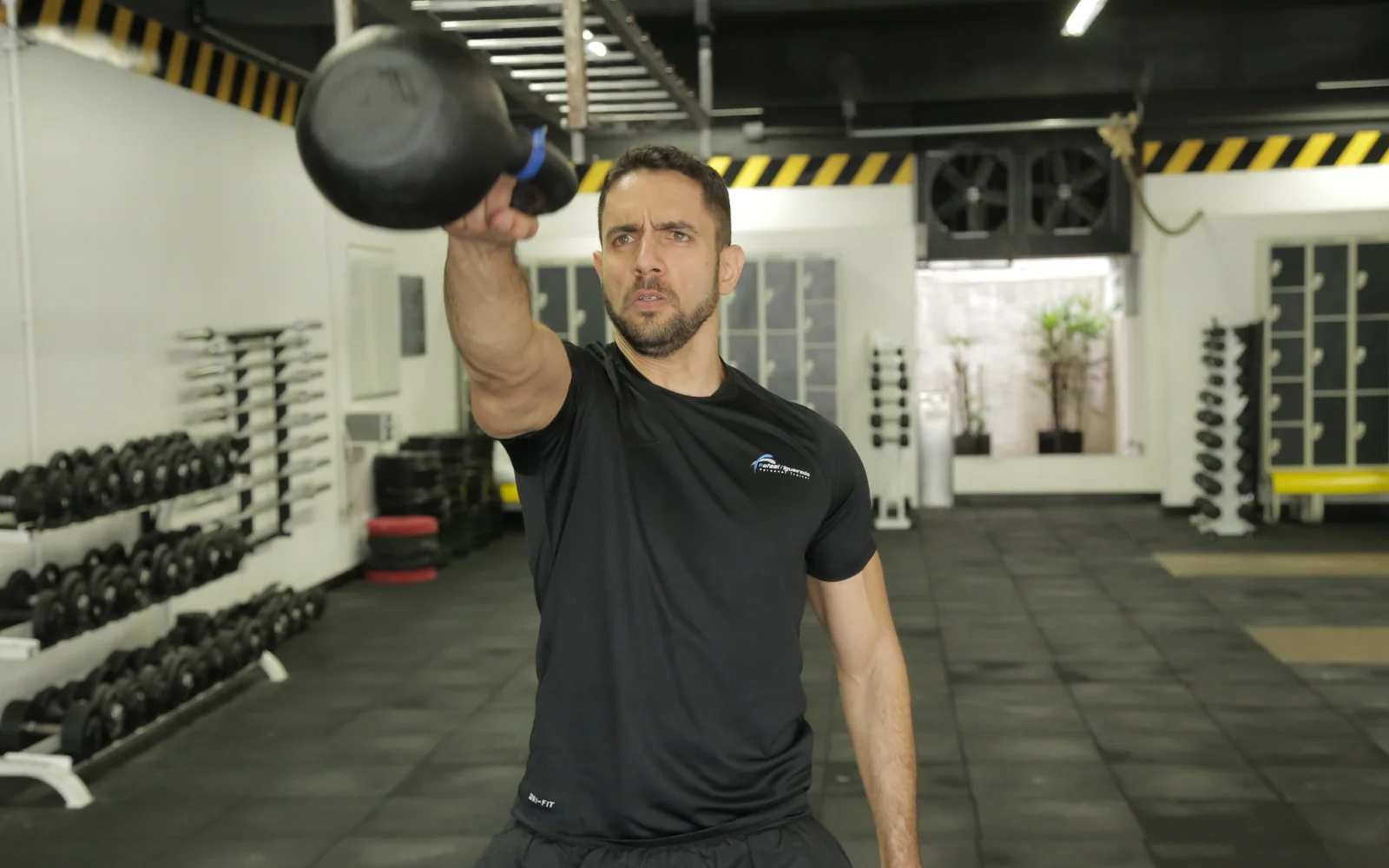
Best Home Gym Setup for $200, $500, and $1,000
Build a real home gym on any budget. Here's exactly what to buy at the $200, $500, and $1,000 price points — with full equipment lists and workouts.
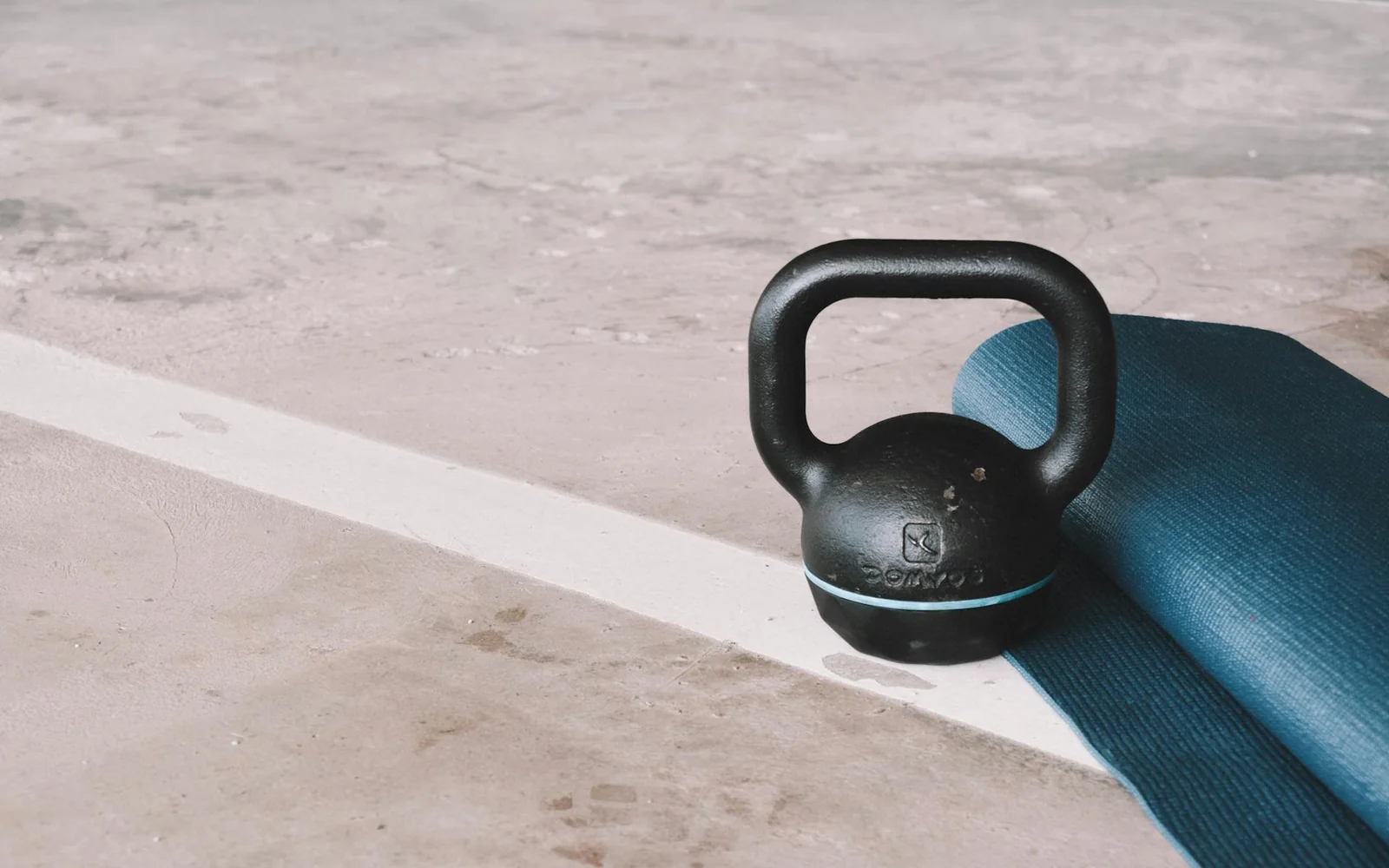
The average gym membership costs $50 per month. In six months, that's $300 — and you have nothing to show for it when you cancel. In a year, it's $600. In two years, $1,200.
Meanwhile, a well-chosen home gym setup can last a decade, requires no commute, no waiting for equipment, no closing time, and no judgment. The math has always favored owning your own gear. The only question is: what do you actually need at each price point?
This guide answers that question precisely. We've broken down three budget tiers — $200, $500, and $1,000 — with exact equipment lists, total costs, space requirements, and sample workouts for each. Whether you're just starting out or ready to build something serious, you'll know exactly what to buy and why.
Key Takeaways
| Your Situation | Best Tier | |---|---| | First home gym, testing the waters | $200 Tier | | Train 3–4x/week, want variety | $500 Tier | | Serious lifter, want to replace the gym | $1,000 Tier | | Already have bands/bar, want to upgrade | Start at $500 and skip what you own | | Limited space (apartment, dorm) | $200 Tier (under 30 sq ft) |
Before You Buy — What to Consider
Before spending a single dollar, answer three questions. The answers will tell you exactly which tier makes sense.
1. How Much Space Do You Have?
Home gym space is often the binding constraint — not budget. Here's a realistic breakdown:
- $200 Tier: Needs as little as 6×5 feet (30 sq ft). You can train in a bedroom corner, hallway, or small living room area. The pull-up bar mounts in a doorframe. Everything else stores in a drawer.
- $500 Tier: Needs roughly 6×6 feet (36 sq ft) once you add a kettlebell. Same footprint as the $200 setup, but the kettlebell needs floor space during swings and Turkish get-ups.
- $1,000 Tier: Needs at least 7×8 feet (56 sq ft) to use a bench safely with dumbbells. Ideally 8×10 (80 sq ft). The Flybird bench folds flat for storage, so daily footprint can shrink significantly.
Apartment lifters: The $200 and $500 setups are excellent apartment-friendly choices. The $1,000 setup works in a large bedroom or dedicated corner — the Flybird bench is specifically designed for space-constrained environments.
2. What Are Your Training Goals?
| Goal | Best Tier | Why | |---|---|---| | Fat loss / conditioning | $200 | Bands + pull-up bar = excellent HIIT and circuit | | Build muscle (beginner) | $200–$500 | Resistance is all beginners need | | Build muscle (intermediate) | $1,000 | Progressive overload requires adjustable weight | | Athletic performance | $500–$1,000 | Kettlebell swings + compound movements | | Injury rehab / flexibility | $200 | Bands are perfect for rehab protocols |
3. What's Your Training Style?
You prefer bodyweight-style training? The $200 setup is perfect and complete.
You like the "feel" of free weights? The $500 setup adds a kettlebell for that. The $1,000 setup gives you full dumbbell programming.
You follow structured lifting programs (like PHUL, PPL, or 5/3/1)? You need the $1,000 setup to progress properly.
A Note on Flooring
Regardless of tier, consider adding a rubber gym mat or interlocking foam tiles ($30–$50) if you're training on hardwood or tile. This protects your floor, reduces noise, and provides grip. It's not included in the budget tiers below but is a worthwhile add-on.
The $200 Home Gym
Total approximate cost: $90–$120 (leaving $80–$110 in your budget for a mat and add-ons)
The $200 home gym is more capable than most people expect. With resistance bands and a doorframe pull-up bar, you can train every major muscle group — chest, back, shoulders, arms, core, glutes, and legs — without any machines or free weights.
This is not a "starter kit you'll outgrow in a month." Intermediate and advanced athletes use resistance bands for warm-ups, activation work, and accessory training. The pull-up bar is arguably the most important strength-training tool a beginner can own.
The $200 Tier Equipment List
| Item | Approximate Price | Why It's Here | |---|---|---| | Fit Simplify Resistance Bands (5-Pack) | $10–$15 | Replaces cable machine for rows, curls, presses, lateral raises | | Iron Gym Pull-Up Bar | $25–$35 | Trains entire upper back, biceps, and core — bodyweight only | | Perfect Fitness Ab Carver Pro | $25–$35 | Roller that works abs, obliques, and arms simultaneously | | Gaiam Essentials Yoga Mat (10mm) | $20–$30 | Floor work, stretching, push-ups, ab roller | | Total | $80–$115 | |
Space needed: 30–36 sq ft
Ceiling height needed for pull-up bar: Standard doorframe (no ceiling clearance issues)
Storage footprint: Everything fits in a medium-sized bag or closet shelf
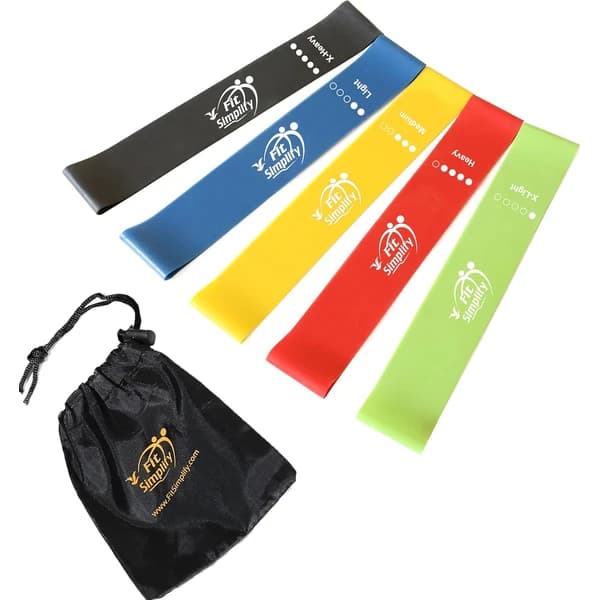
Fit Simplify Resistance Loop Bands
The Fit Simplify 5-Pack includes five bands in increasing resistance levels (2, 4, 6, 8, and 12+ lbs). They're made from natural latex, not cheap TPE, and have held up for years of daily use per customer reviews. Amazon's Choice with over 80,000 reviews — among the most popular fitness products on the platform.
These bands replace cables for pulling exercises, add resistance to push-ups and squats, and are essential for glute and hip work that would otherwise require machines.
Amazon · Affiliate
Fit Simplify Resistance Loop Bands (5-Pack)
4.7
Premium latex resistance bands for all fitness levels. Perfect for home workouts, stretching, and rehab.
$10–$15Check Price on Amazon
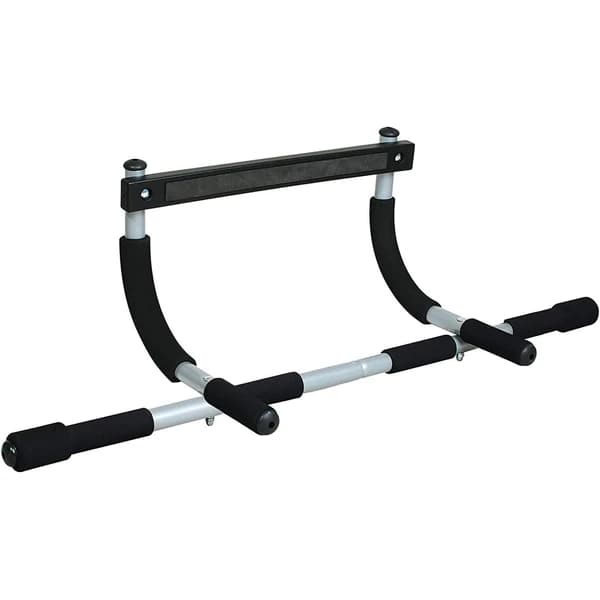
Iron Gym Total Upper Body Workout Bar
No screws, no installation, no damage to your doorframe. The Iron Gym bar sits on the molding of a standard doorframe using a leverage system that gets tighter the harder you pull. It holds up to 300 lbs and has been on the market for decades.
Beyond pull-ups and chin-ups, this bar turns your floor into a push-up station when placed flat, and it doubles as a dip station with the included handles. Rated 4.5 stars with tens of thousands of reviews.
Amazon · Affiliate
Iron Gym Total Upper Body Workout Bar
4.5
Doorframe pull-up bar with no screws required. Supports up to 300 lbs. Doubles as a dip station.
$25–$35Check Price on Amazon
What the $200 Setup Can Train
Here's every muscle group you can target with just bands and a pull-up bar:
- Back: Pull-ups, chin-ups, band rows, band pull-aparts
- Chest: Push-ups (hands elevated or declined on bar), band flyes, band chest press
- Shoulders: Band lateral raises, band overhead press, band front raises
- Biceps: Band curls, chin-ups (supinated grip)
- Triceps: Band pushdowns, tricep push-ups, close-grip push-ups
- Core: Ab roller, hanging knee raises on pull-up bar, band Pallof press, planks
- Glutes/Legs: Band squats, band hip thrusts, band lateral walks, band Romanian deadlifts, step-ups
- Calves: Calf raises (bodyweight, can add band resistance)
That's a full-body training program. You are not missing muscle groups. You are missing some loading options — which is the honest limitation of the $200 tier.
The Honest Limitation of the $200 Setup
The $200 tier maxes out faster for the lower body than the upper body. Band squats and hip thrusts plateau sooner than pull-ups do, because your legs are stronger and can generate more force than bands can resist. If lower body strength is your primary goal, you'll want to upgrade to the $500 tier (kettlebell) or $1,000 tier (adjustable dumbbells) within 6–12 months.
For the upper body, intermediate-level pull-up progressions (archer pull-ups, typewriter pull-ups, L-sit pull-ups) and ring work can challenge even advanced athletes.
The $500 Home Gym
Total approximate cost: $120–$175 (well under $500, with significant room for add-ons)
The $500 tier adds one item to the $200 setup: a kettlebell. That's it. But the addition of even a single kettlebell dramatically expands what you can train — particularly for lower body strength, power development, and unilateral work.
If you already own the $200 setup, upgrading to $500 means spending $30–$60 on a CAP kettlebell.
The $500 Tier Equipment List
| Item | Approximate Price | Why It's Added | |---|---|---| | Everything in the $200 tier | $80–$115 | See above | | CAP Barbell Cast Iron Kettlebell (1–2 units) | $30–$120 | Swings, deadlifts, goblet squats, presses, carries | | Total | $110–$235 | |
Space needed: 36–50 sq ft (swings require ceiling clearance and arm extension space)
Recommended kettlebell weight for beginners: 25–35 lbs for men, 15–25 lbs for women
The Case for the Kettlebell
No single piece of fitness equipment produces as much training variety per dollar as a kettlebell. Here's what one kettlebell adds to your routine that bands and a pull-up bar cannot replicate:
- Loaded hip hinge — The kettlebell swing is unmatched for posterior chain development (hamstrings, glutes, lower back). Bands can approximate it but never load it the same way.
- True goblet squat — Holding a kettlebell at your chest during a squat provides counterbalance and teaches proper form better than any machine.
- Single-arm press — Builds shoulder stability while pressing, something bands struggle to replicate at higher loads.
- Turkish get-up — A full-body movement that builds mobility, strength, and proprioception simultaneously.
- Farmer carries — Grip strength, core stability, and conditioning in one loaded walk.
Which Weight to Buy?
For a beginner's first kettlebell:
- Men: 35 lbs (16 kg) — heavy enough for swings and lower body work, manageable for overhead press
- Women: 18–26 lbs (8–12 kg) — appropriate for most movements, can add a second heavier bell later
For the $500 budget, buying two kettlebells (light and moderate) gives you options for paired work and heavier single-leg exercises.
CAP Barbell Cast Iron Kettlebell
CAP's cast iron kettlebell is a single-piece construction — no welds, no seams, no handles separating from the bell under load. The flat base means it can sit on the floor without rolling. Available from 5 to 80 lbs at budget-friendly prices that have made it consistently one of Amazon's best-selling kettlebell options. Rated 4.7 stars.
Amazon · Affiliate
CAP Barbell Cast Iron Kettlebell
4.7
Single-piece cast iron construction. Flat base for stability. Available in multiple weights from 5 to 80 lbs. Budget-friendly.
$15–$60Check Price on Amazon
What the $500 Setup Adds
With a kettlebell added to your $200 setup, your weekly training can look like this:
Day 1 (Pull-focused): Pull-ups, kettlebell rows, band pull-aparts, band curls
Day 2 (Push + Core): Push-ups, band overhead press, kettlebell floor press, ab roller
Day 3 (Legs + Hips): Kettlebell swings, goblet squats, single-leg deadlifts, band hip thrusts
Day 4 (Full Body): Turkish get-up, farmer carries, band squats, pull-ups
This is a legitimate intermediate-level training program. You are not "making do" at this tier — you are training effectively.
Should You Buy One Kettlebell or Two?
Start with one, at the "swing" weight (the heaviest you can swing safely for 20 reps). After 6–8 weeks, you'll have a clear sense of whether you need a lighter bell for overhead work or a heavier bell for loaded carries. Buying two different weights up front is fine if budget allows.
The $1,000 Home Gym
Total approximate cost: $600–$750 (the most capable setup that fits a home environment)
The $1,000 tier is where your home gym becomes a genuine replacement for a commercial gym — for the vast majority of fitness goals. This setup adds two premium items to the $500 configuration: the Bowflex SelectTech 552 adjustable dumbbells and the Flybird adjustable weight bench.
Together, they unlock every pressing and pulling variation, true progressive overload with specific weights, and seated/inclined/declined exercise angles that the lower tiers simply cannot provide.
The $1,000 Tier Equipment List
| Item | Approximate Price | Why It's Added | |---|---|---| | Everything in the $500 tier | $110–$235 | See above | | Bowflex SelectTech 552 Adjustable Dumbbells | $300–$400 | Replaces 15 pairs of dumbbells, 5–52.5 lbs range | | Flybird Adjustable Weight Bench | $140–$200 | Incline/decline/flat press, seated work, step-ups | | Total | $550–$835 | Well within $1,000 budget |
Space needed (bench + dumbbell movements): 56–80 sq ft
Storage when not in use: Bench folds flat (~18" wide), dumbbells sit on included tray
Why Adjustable Dumbbells Change Everything
Free weights are the foundation of most serious strength training programs because they:
- Train stabilizer muscles that machines and cables cannot reach
- Allow natural movement patterns — your joints move through their own range of motion
- Enable unilateral training — training one limb at a time, critical for fixing imbalances
- Scale indefinitely — you can always add more weight as you grow stronger
The problem with traditional dumbbells is the space: a full set from 5 to 52.5 lbs requires 15 pairs and roughly 8 feet of rack space. The Bowflex SelectTech 552 replaces all of that with a single pair stored on a compact tray.
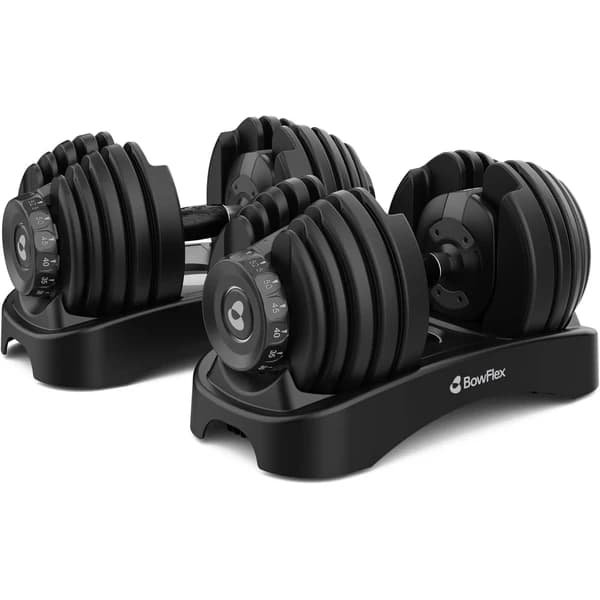
Bowflex SelectTech 552 Adjustable Dumbbells
The SelectTech 552 has over 25,000 five-star reviews on Amazon — one of the highest review counts of any fitness product available. The dial system changes weight in seconds, adjusting from 5 to 52.5 lbs in 2.5-lb increments (up to 25 lbs) and 5-lb increments above that.
At the $300–$400 price point, this is a premium purchase — but when you consider that a single 35-lb fixed dumbbell costs $60–$80 alone, the SelectTech pays for itself within 6–7 equivalent pairs. These last for years and are backed by Bowflex's 2-year warranty. Rated 4.8 stars.
Amazon · Affiliate
Bowflex SelectTech 552 Adjustable Dumbbells
4.8
Replace 15 sets of weights. Dial adjusts from 5 to 52.5 lbs. Space-saving design for home gyms.
$300–$400Check Price on Amazon
Why the Bench Matters
Without a bench, most pressing movements happen on the floor. Floor press is useful, but it limits the range of motion of your elbows and prevents true incline or declined movement patterns.
An adjustable bench lets you do:
- Flat dumbbell press — the foundation of chest training
- Incline dumbbell press — emphasizes upper chest and front delts
- Decline press — hits lower chest
- Seated dumbbell overhead press — strict shoulder work with back support
- Incline dumbbell curl — lengthened-position bicep work
- Chest-supported row — eliminates lower back from the equation
- Step-ups — loaded step-up exercises for single-leg strength
Flybird Adjustable Weight Bench
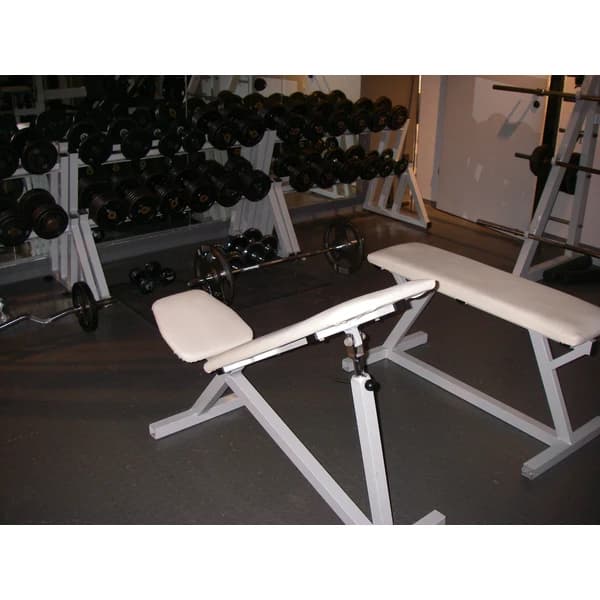
The Flybird bench has 7 back-pad positions (from flat to 85 degrees) and a 620-lb weight capacity. The fold-flat design makes it ideal for home use — you can store it upright against a wall, tucking it out of the way after training.
Among home gym benches under $200, the Flybird has consistently ranked as the top recommendation across fitness communities. Rated 4.6 stars with strong reviews specifically praising the sturdy construction and ease of adjustment. It ships assembled and ready to use.
Amazon · Affiliate
Flybird Adjustable Weight Bench
4.6
7 back-pad positions, folds flat for storage. 620 lb weight capacity. Great for dumbbell chest, shoulder, and incline press at home.
$140–$200Check Price on Amazon
What the $1,000 Setup Can Train
The $1,000 setup covers every major movement pattern:
| Pattern | Exercise(s) | |---|---| | Horizontal push | Dumbbell bench press (flat, incline, decline) | | Vertical push | Dumbbell overhead press, Arnold press | | Horizontal pull | Chest-supported row, bent-over row | | Vertical pull | Pull-ups, chin-ups, band lat pulldown | | Hip hinge | Kettlebell swing, Romanian deadlift | | Squat | Goblet squat, dumbbell squat, split squat | | Core | Ab roller, Pallof press, hanging leg raises | | Accessory | Lateral raises, curls, tricep extensions, face pulls |
This is a complete strength training menu. The only commercial gym exercises you genuinely cannot replicate are barbell squats, barbell deadlifts, and machine-based isolation work — none of which are necessary for most fitness goals.
How to Prioritize If You're Building Up Over Time
You don't have to buy a full tier at once. Here's the smart order of acquisition if you're starting from zero and building toward the $1,000 setup over 12–18 months:
Month 1: Start With the Pull-Up Bar ($25–$35)
The pull-up bar is the most impactful single item you can own. It trains your back, biceps, and core using your own bodyweight — which is significant for most beginners. Start here.
What you can do immediately:
- Pull-ups (or Australian rows using the bar placed low)
- Push-ups (using bar handles on the floor)
- Hanging core work (knee raises, L-holds)
Month 2: Add Resistance Bands ($10–$15)
Bands expand your training library from ~10 exercises to 30+. They're cheap enough to add in month two without a meaningful budget impact.
Month 3–4: Add a Kettlebell ($30–$60)
Once you've established a training habit, add a kettlebell. You'll have clear feedback on what weight to buy based on 2–3 months of bodyweight training.
Month 6–12: Add the Adjustable Dumbbells ($300–$400)
This is the biggest purchase and should come after you've confirmed you're committed to training at home. By month 6, you'll know whether home training works for your lifestyle.
Month 12–18: Add the Bench ($140–$200)
The bench comes last because it provides the most value when paired with adjustable dumbbells. Buying the bench without dumbbells significantly limits its utility.
What NOT to Buy
Home gym shopping is full of expensive traps. Here's what to skip:
1. Full Weight Sets (Fixed Dumbbell Pairs)
Buying fixed dumbbells in multiple weights is expensive and wastes space. A set from 5 to 50 lbs (even one pair each) costs $400–$600 and takes up a full rack. The Bowflex SelectTech does the same thing in a 17-inch footprint for the same price.
Skip unless: You specifically want to train with fixed dumbbells (some people prefer the feel) and have dedicated floor space.
2. Budget Adjustable Dumbbells (Under $100)
Amazon is full of "adjustable dumbbell" sets at $60–$90. These typically use a pin-and-plate system with plastic parts that crack under stress. The dial systems fail within months of heavy use. The weight range is usually 5–25 lbs — too light for any intermediate training.
Spend the $300–$400 on the Bowflex SelectTech or wait until you can. A broken dumbbell mid-workout is dangerous.
3. Resistance Band "Systems" With Handles and Doors
Tube-style resistance band "gym replacement" kits ($30–$80) promise to replace your gym. They don't. The resistance is inconsistent, the anchors break, and the bands snap after moderate use. Stick to quality loop bands (like the Fit Simplify set) and a pull-up bar — those actually work.
4. Smart Mirrors and Subscription-Based Home Gym Systems
Products like the Mirror, Tempo, or Tonal cost $1,000–$4,000 plus $40/month subscriptions. You don't need a screen to tell you how to do a pull-up. Everything in this guide totals $600–$750 without a subscription.
5. A Treadmill or Elliptical for Cardio
Unless you live somewhere with no outdoor running space, a treadmill is the least-efficient use of home gym budget. They take up enormous space, cost $400–$1,500+, require maintenance, and can be replaced by a $10 jump rope and an outdoor path for almost everyone.
If cardio equipment is important to you, a rowing machine or stationary bike (compact, foldable models) are more space-efficient alternatives. But for budget home gyms, leave cardio for outdoors.
6. A Squat Rack Under $300
Squat racks under $300 flex dangerously under load and have failed with people inside them. If you want to squat heavy, budget $400–$600 for a quality rack — or do barbell work at the gym and train everything else at home.
Sample Workouts for Each Tier
Here are complete sample workout programs for each budget tier. These are beginner-to-intermediate programs — accessible if you're new, challenging if you push them.
Tier 1: $200 Setup Workout Plan (4 Days/Week)
Day A — Upper Pull
- Pull-ups (or band-assisted) — 4 sets to near failure
- Band face pull — 3×15
- Band row (anchor to door) — 3×15 per side
- Band bicep curl — 3×12
- Ab roller — 3×8
Day B — Upper Push + Core
- Push-ups — 4×max
- Band overhead press — 3×12
- Band lateral raise — 3×15
- Band tricep pushdown — 3×15
- Plank — 3×45 seconds
- Ab roller — 3×8
Day C — Lower Body + Hips
- Band squat — 4×20 (use heaviest band)
- Band hip thrust — 4×15 per side
- Band Romanian deadlift — 3×12
- Band lateral walk — 3×20 steps each direction
- Band calf raises — 3×20
Day D — Full Body Circuit
- 4 rounds: Pull-ups (max), Push-ups (max), Band squat (20 reps), Ab roller (8 reps)
- Rest 2 minutes between rounds
Progressive overload: Add 1 rep or move to a heavier band each week. When you can do 15+ pull-ups, consider a weighted vest.
Tier 2: $500 Setup Workout Plan (4 Days/Week)
Builds on the $200 plan by adding kettlebell work.
Day A — Strength + Pull
- Pull-ups — 4 sets to near failure
- Kettlebell single-arm row — 4×10 per side
- Band face pull — 3×15
- Kettlebell floor press — 3×10 per side
- Ab roller — 3×8
Day B — Power + Conditioning
- Kettlebell swing — 5×20
- Goblet squat — 4×12
- Push-ups — 3×max
- Band lateral walk — 3×20 steps
- Kettlebell Turkish get-up — 3×3 per side
Day C — Upper Hypertrophy
- Push-ups (weighted with band) — 4×max
- Band overhead press — 4×12
- Chin-ups — 4×max
- Kettlebell curl — 3×12 per side
- Kettlebell overhead press — 3×10 per side
Day D — Lower Strength + Carries
- Kettlebell single-leg Romanian deadlift — 4×8 per side
- Kettlebell goblet squat — 4×15
- Band hip thrust — 4×15
- Kettlebell farmer carry — 5×40 steps
- Ab roller — 3×10
Tier 3: $1,000 Setup Workout Plan (4 Days/Week)
A proper Push/Pull/Lower/Full split.
Day A — Push (Chest, Shoulders, Triceps)
- Dumbbell flat bench press — 4×8–10
- Dumbbell incline press — 3×10
- Dumbbell overhead press — 3×10
- Dumbbell lateral raise — 4×15
- Band tricep pushdown — 3×15
- Dumbbell overhead tricep extension — 3×12
Day B — Pull (Back, Biceps)
- Pull-ups — 4×max
- Chest-supported dumbbell row — 4×10
- Dumbbell single-arm row — 3×12 per side
- Band face pull — 4×15
- Dumbbell incline curl — 3×12
- Dumbbell hammer curl — 3×12
Day C — Lower (Legs, Glutes, Hips)
- Dumbbell goblet squat — 4×12
- Dumbbell Romanian deadlift — 4×10
- Dumbbell Bulgarian split squat — 3×10 per side
- Kettlebell swing — 4×20
- Dumbbell step-up (on bench) — 3×12 per side
- Band hip thrust — 3×20
Day D — Full Body + Conditioning
- Kettlebell Turkish get-up — 3×3 per side
- Dumbbell bench press — 3×10
- Pull-ups — 3×max
- Kettlebell swing — 5×15
- Ab roller — 4×8
- Dumbbell farmer carry — 5×40 steps
Progressive overload: Increase weight by 2.5–5 lbs every 1–2 weeks once you can complete all sets at the top of the rep range with clean form.
Frequently Asked Questions
Can I build muscle with just resistance bands?
Yes — especially as a beginner. Research shows that elastic resistance can produce similar muscle growth to free weights when matched for intensity and progressive overload. The limitation is practical: it's harder to precisely quantify and progress resistance with bands than with fixed weights.
Do I need a gym mat?
Strongly recommended for any floor work. Even a $20–$30 budget mat (like the Gaiam Essentials) prevents equipment from sliding, protects hardwood, and makes core work more comfortable.
What about cardio? None of these tiers include a cardio machine.
Intentionally. Cardio machines are the worst ROI for home gym budgets. Use the equipment above for circuit training and HIIT (kettlebell swings, jump rope if you want to add one, pull-up bar knee raises). Supplement with outdoor running or cycling for steady-state cardio.
How long will this equipment last?
- Resistance bands: 2–5 years with regular use (replace when you see micro-tears)
- Pull-up bar: 10+ years (it's just steel)
- CAP kettlebell: Effectively forever (cast iron doesn't wear)
- Bowflex SelectTech: 5–10 years; dial mechanism can be repaired or replaced
- Flybird bench: 5–10 years with normal use
Is $200 really enough to get a good workout?
For a beginner, yes — unequivocally. The limiting factor early in your training career is not equipment; it's your own body's adaptation. A pull-up bar, resistance bands, and bodyweight movements will drive months of meaningful progress before you plateau.
Final Thoughts
Here's what this guide boils down to:
At $200: You have everything you need to start building real strength and conditioning from home. Don't let the low price fool you — a pull-up and band training program will challenge you more than you expect.
At $500: Adding a kettlebell completes your functional strength toolkit. Swings, goblet squats, and Turkish get-ups are among the highest-value exercises in existence. This setup is legitimately excellent.
At $1,000: The Bowflex SelectTech dumbbells and Flybird bench turn your home into a commercial gym substitute. For the vast majority of training goals, you will never need more equipment than this.
The best home gym is the one you'll actually use. Start at the tier that fits your budget and space today — you can always add equipment as you grow. But don't wait for the "perfect" setup before you start training.
Pick a tier. Buy the gear. Start next week.
All prices are approximate and reflect typical Amazon pricing as of 2026. Prices may vary. Check current listings for the most accurate pricing before purchasing.
Affiliate disclosure: Some links in this article are affiliate links. If you purchase through them, we may earn a small commission at no extra cost to you. We only recommend products we genuinely believe in.
About the author
Nathan reviews the research, tests the tools, and writes the guides at LeanBodyEngine — evidence-first, no sponsored content, no supplement shilling.
Related articles
Subscribe
Never miss a new article
Get an email whenever we publish a new fitness guide, supplement review, or workout plan. One short email per post — that's it.
Unsubscribe anytime. We only email when there's a new post.