
How to Track Macros for Beginners: The Complete Guide to Hitting Your Numbers
Learn how to track macros for beginners — from calculating TDEE and macro targets to the best apps, tools, and meal prep strategies.
How to Track Macros for Beginners: The Complete Guide to Hitting Your Numbers
Most people don't fail their diet because they lack willpower. They fail because they lack data. If you've ever eaten "pretty healthy" for two weeks and seen zero progress on the scale, the problem isn't your food choices — it's that you're flying blind. Tracking macros turns nutrition from guesswork into a measurable system, and this guide will walk you through every step of doing it correctly.
Key Takeaways
- Macros (macronutrients) are protein, carbohydrates, and fat — the three nutrients your body uses for energy and function.
- Your macro targets are calculated from your TDEE (Total Daily Energy Expenditure) and your goal (fat loss, muscle gain, or maintenance).
- A digital food scale is the single most important tool for accurate tracking — eyeballing portions is wrong by 30–40% on average.
- Apps like Cronometer and MyFitnessPal make daily logging take under 3 minutes once you've built your staple food list.
- Meal prep dramatically reduces tracking friction by letting you weigh and log food in bulk rather than every single meal.
- Protein supplements are a practical (not mandatory) way to close daily protein gaps without extra cooking.
What Are Macros and Why They Matter
Macronutrients — or macros — are the three major nutrients that provide your body with calories and fuel every biological process you care about: energy, muscle repair, hormone production, and cognitive function.
- Protein (4 calories per gram) — builds and repairs muscle tissue, keeps you full, and preserves lean mass during fat loss. Sources: chicken, eggs, fish, Greek yogurt, protein powder.
- Carbohydrates (4 calories per gram) — your body's preferred fuel for high-intensity exercise, brain function, and mood regulation. Sources: oats, rice, potatoes, fruit, vegetables.
- Fat (9 calories per gram) — essential for hormone synthesis (including testosterone and estrogen), fat-soluble vitamin absorption, and cell membrane integrity. Sources: avocado, olive oil, nuts, fatty fish.
Unlike just counting calories, tracking macros ensures that the calories you eat are doing the right job. You can eat 2,000 calories of only candy or 2,000 calories of protein and vegetables — your weight change will be similar in the short term, but your body composition, performance, and health outcomes will be completely different.
The Three Goals and Why They Need Different Ratios
Different goals require different macro splits because each goal stresses different physiological processes:
| Goal | Protein | Carbs | Fat | Notes | |---|---|---|---|---| | Fat Loss | 35–40% | 30–35% | 25–30% | High protein preserves muscle in a deficit | | Muscle Gain | 25–30% | 40–50% | 20–25% | Higher carbs fuel training and recovery | | Maintenance | 25–30% | 40–45% | 25–30% | Balanced for general health and performance |
These are percentage-of-calories ranges, not absolute rules — individual response varies. But they give you a solid starting framework before you dial in based on how your body responds.
Step 1 — Calculate Your TDEE and Macro Targets
Finding Your TDEE
Your TDEE (Total Daily Energy Expenditure) is the total number of calories your body burns each day, including your base metabolism, digestion, and physical activity. It's your maintenance number — the calorie level at which your weight stays the same.
The most accurate beginner-friendly method is the Mifflin-St Jeor equation:
Men: BMR = (10 × weight in kg) + (6.25 × height in cm) − (5 × age) + 5
Women: BMR = (10 × weight in kg) + (6.25 × height in cm) − (5 × age) − 161
Then multiply your BMR by an activity factor:
| Activity Level | Multiplier | |---|---| | Sedentary (desk job, minimal exercise) | × 1.2 | | Lightly active (1–3 light sessions/week) | × 1.375 | | Moderately active (3–5 sessions/week) | × 1.55 | | Very active (6–7 hard sessions/week) | × 1.725 | | Extremely active (physical job + daily training) | × 1.9 |
Worked example — 28-year-old man, 178 cm, 82 kg, moderately active:
BMR = (10 × 82) + (6.25 × 178) − (5 × 28) + 5 = 820 + 1,112.5 − 140 + 5 = 1,797.5 calories
TDEE = 1,797.5 × 1.55 = ~2,786 calories/day
Adjust for your goal:
- Fat loss: Subtract 15–20% from TDEE (roughly 2,230–2,370 calories in this example)
- Maintenance: Eat at TDEE
- Lean bulk: Add 10–15% above TDEE (roughly 3,060–3,200 calories)
Setting Your Macro Targets
Once you have your calorie target, use the protein-first method:
- Set protein first: 0.7–1.0 g per pound of bodyweight (go higher in a deficit to protect muscle)
- Set fat minimum: 0.3–0.5 g per pound of bodyweight (never go below 20% of total calories)
- Fill with carbs: remaining calories ÷ 4
Sample 2,000-calorie day — fat loss plan for a 160 lb person:
| Macro | Grams | Calories | % of Total | |---|---|---|---| | Protein | 160 g | 640 cal | 32% | | Fat | 60 g | 540 cal | 27% | | Carbohydrates | 205 g | 820 cal | 41% | | Total | 425 g | 2,000 cal | 100% |
A 2020 meta-analysis in the British Journal of Sports Medicine reviewing 49 controlled studies found that protein intakes of at least 0.73 g per pound of bodyweight produced 27% more lean mass gains during resistance training compared to lower-protein diets. That number goes up in a calorie deficit, making adequate protein non-negotiable.
Step 2 — The Tool That Makes or Breaks Accuracy
There is one piece of equipment that separates guessers from actual trackers: a digital food scale. No app, no method, and no experience level can compensate for eyeballed portions. A 2013 Cornell Food and Brand Lab study found that untrained subjects estimated portion sizes incorrectly by an average of 30–40% — which translates to 300–500 invisible calories per day on a 2,000-calorie plan.
Consider what "a tablespoon of peanut butter" looks like in reality: most people scoop 2–3 tablespoons, turning a 95-calorie serving into 285 calories. Do that three times a day and you've just added over 500 unaccounted calories.
How to Use a Food Scale Correctly
- Weigh raw, not cooked — Cooking changes the water content of food significantly. 100g of raw chicken becomes ~70g cooked, but the calories stay the same. Always log food in its raw state unless the label specifically says "cooked."
- Use the tare function — Place your bowl or container on the scale, press tare to zero it out, then add your food. This removes the weight of the container.
- Weigh liquids by grams or mL — Water is 1g per mL, but oils and sauces have different densities. Use the gram setting for accuracy.
- Weigh protein powder — A "scoop" of protein powder varies by 5–10 grams between servings. Weigh it instead.
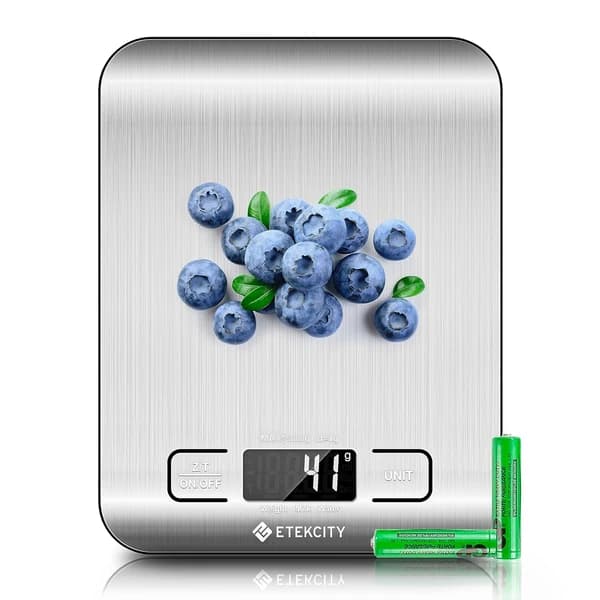
The Etekcity Digital Food Scale is the standard entry-level recommendation — 0.1g precision, tare function, backlit display, measures in grams/oz/mL, and costs under $16. At that price point, it's genuinely the highest-ROI item in your macro-tracking toolkit.
Amazon · Affiliate
Etekcity Digital Food Scale (0.1g precision)
4.7
Measures in grams, ounces, pounds, and milliliters. Tare function, backlit display, auto-off. Essential for accurate macro tracking.
$10–$16Check Price on Amazon
Step 3 — Choosing a Tracking App
The right app turns a 20-minute chore into a 2-minute habit. Here's how the most popular options compare for beginners:
| App | Best For | Database Size | Barcode Scan | Free Macro Tracking | |---|---|---|---|---| | MyFitnessPal | Large database, social features | 14M+ foods | Yes | Limited (premium for full macros) | | Cronometer | Accuracy + micronutrient detail | ~1.3M verified | Yes | Full macros + 60+ micros | | Lose It! | Simple UI, fast daily logging | ~10M foods | Yes | Solid free tier | | MacroFactor | Auto-adjusting targets based on real data | 1M+ verified | Yes | Free trial, then paid |
Beginner recommendation: Start with Cronometer (accuracy and free full macros) or Lose It! (simplest interface). Avoid relying entirely on MyFitnessPal's user-submitted database — entries are frequently duplicated and inaccurate, which defeats the entire purpose of careful tracking.
Getting Started With Your App in 30 Minutes
- Enter your stats (height, weight, age, activity level)
- Set your goal and let the app suggest a calorie target — or override it with your own Mifflin-St Jeor calculation
- Spend 20 minutes adding your 15–20 most common foods to your favorites list. After this initial setup, daily logging takes 2–3 minutes.
- Enable the barcode scanner and use it for everything packaged
- Log immediately after weighing, not later from memory — memory-based logging is inaccurate by up to 45% according to dietary recall research
Pro tip: Log your next day's meals the night before ("pre-logging"). This takes 5 minutes before bed and lets you identify macro gaps before it's too late to fix them. It also dramatically reduces the cognitive load of tracking.
Step 4 — Meal Prep Makes Tracking Easy
The biggest reason people abandon macro tracking isn't complexity — it's friction. Weighing and logging individual ingredients for every meal, every day, is genuinely annoying. Meal prep solves this completely.
When you cook in bulk once or twice per week, you:
- Weigh ingredients once when assembling, not six separate times per day
- Log an entire meal once and repeat it
- Eliminate "I don't know what's in this" panic meals
- Always have macro-known food ready in the fridge
A Simple Beginner Meal Prep System
Sunday prep (90 minutes) covers 5 days of lunches and dinners:
- Protein base (1.5–2 lbs): Bake chicken breasts at 400°F for 22–25 minutes. Weigh raw before cooking, log as raw chicken. Divide into 5 equal portions.
- Carb base: Cook 2 cups dry rice (becomes ~6 cups cooked). Portion equally.
- Vegetables: Roast 2 trays of broccoli, bell peppers, or zucchini with olive oil. Weigh the oil before cooking.
- Sauces: Portion any sauces or condiments into small containers — these are where hidden calories live.
Divide everything into individual containers and refrigerate. Each container is now a logged, macro-known meal you can grab in under 30 seconds.
Glass containers are preferable to plastic for meal prep: they're microwave-safe, don't absorb food odors, and the portion sizes stay visible. The Prep Naturals borosilicate glass containers are oven, microwave, freezer, and dishwasher safe — a 10-pack gives you enough for a full week of lunches and dinners.
Amazon · Affiliate
Prep Naturals Glass Meal Prep Containers (10-Pack)
4.7
1-cup and 2-cup borosilicate glass containers. Oven, microwave, freezer, and dishwasher safe. Ideal for weekly meal prep.
$35–$50Check Price on Amazon
Quick-Reference Macro Dense Foods for Meal Prep
| Food | Serving | Protein | Carbs | Fat | Calories | |---|---|---|---|---|---| | Chicken breast (raw) | 100g | 23g | 0g | 2g | 110 | | 93% lean ground beef (raw) | 100g | 21g | 0g | 7g | 152 | | Whole eggs | 2 large | 12g | 1g | 10g | 143 | | White rice (dry) | 45g | 3g | 36g | 0g | 160 | | Sweet potato (raw) | 150g | 2g | 33g | 0g | 140 | | Greek yogurt (2%) | 170g | 17g | 8g | 4g | 130 | | Broccoli (raw) | 100g | 3g | 7g | 0g | 34 |
When Protein Supplements Help
Protein supplements are not magic, and they're not required. But they solve a real problem that most beginners run into: protein targets feel unreachable on whole-food alone, especially for people who aren't big meat eaters, are busy, or are eating in a calorie deficit that limits food volume.
A single scoop of whey protein delivers 24–25g of high-quality protein in about 150 calories and 30 seconds of effort. That same 25g of protein from chicken breast requires cooking 110g of raw chicken — a different kind of commitment when you're tired at 9 PM and still 40g short of your target.
When protein powder makes sense:
- You're consistently under your protein target by 20g or more
- You're vegan or lactose intolerant (plant-based option)
- You need a fast post-workout option
- You're in a deficit and struggling to hit protein without going over calories
Best Whey: Optimum Nutrition Gold Standard
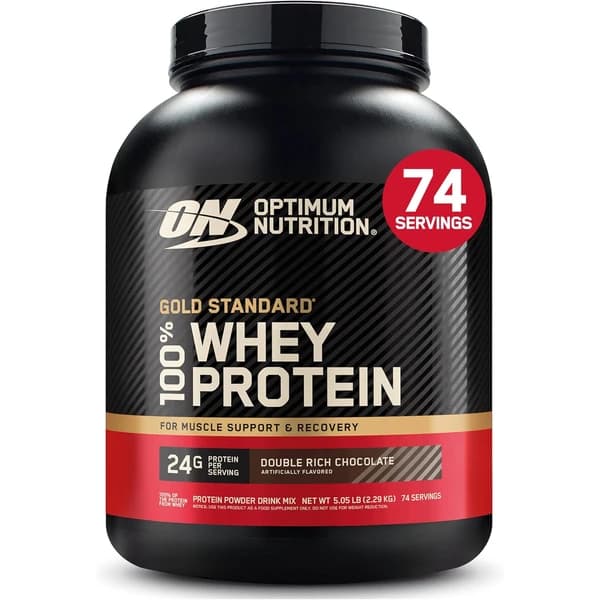
ON Gold Standard Whey has been the world's #1 selling whey protein for over 20 years — not because of marketing, but because it consistently delivers 24g of protein per serving with a clean ingredient profile, excellent mixability, and a range of flavors that don't taste artificial. It's third-party tested, widely available, and sits in the $30–$60 range depending on size. Rated 4.8 stars across hundreds of thousands of verified reviews.
Amazon · Affiliate
Optimum Nutrition Gold Standard 100% Whey
4.8
The world's best-selling whey protein powder. 24g protein per serving, low sugar, mixes easily.
$30–$60Check Price on Amazon
Best Plant-Based Budget Pick: Orgain Organic Protein
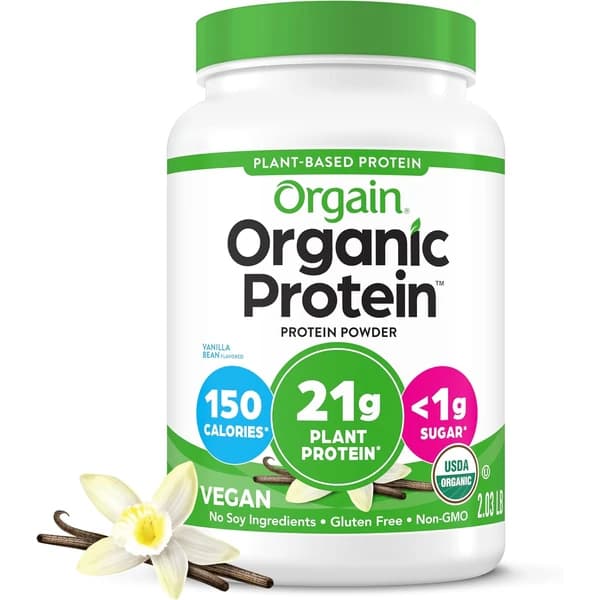
If you're vegan, lactose intolerant, or just prefer plant-based nutrition, Orgain Organic Protein delivers 21g of protein per serving from a pea/chia/brown rice blend. It's USDA organic, non-GMO, dairy-free, and soy-free. At $20–$35, it's the most cost-accessible plant-based protein that doesn't sacrifice on flavor or mixability. Rated 4.5 stars with over 50,000 verified Amazon reviews.
Amazon · Affiliate
Orgain Organic Protein Powder (Plant-Based)
4.5
21g of organic plant protein per serving. Dairy-free, soy-free, non-GMO. Great for vegans and those with lactose intolerance.
$20–$35Check Price on Amazon
Protein powder comparison:
| Product | Protein/Serving | Calories | Type | Price Range | Best For | |---|---|---|---|---|---| | ON Gold Standard Whey | 24g | ~120 cal | Whey concentrate/isolate | $30–$60 | Most people; premium pick | | Orgain Organic Protein | 21g | ~150 cal | Plant-based blend | $20–$35 | Vegan; dairy-free; budget |
Common Macro Tracking Mistakes (And How to Fix Them)
Even motivated beginners hit the same walls. These six mistakes account for the vast majority of "I'm tracking but not seeing results" situations.
1. Not Weighing Food
This is the most common and costly mistake. If you're not using a scale, you're not tracking — you're estimating. Estimating is fine for general healthy eating, but it completely defeats the purpose of macro tracking. The Cornell study mentioned earlier found 30–40% error rates in trained nutrition students, not beginners off the street. Use the scale every time.
2. Forgetting Oils, Butter, and Condiments
Olive oil is 120 calories per tablespoon. Butter is 100 calories per tablespoon. A generous pour of ranch dressing on a salad can be 200+ calories. These are the silent calorie sinks that keep people stuck in a plateau they can't explain. Log every oil, every sauce, every condiment — even the spray of cooking oil (about 20–30 calories per second of spraying, despite the "0 calorie" label being based on a per-serving rounding trick).
3. Trusting Calorie Burns From Wearables
A 2017 Stanford study tested seven popular fitness trackers and found heart rate accuracy was reasonable — but calorie burn estimates were off by 27–93% across devices. If you're "eating back" exercise calories from your watch, you're almost certainly overestimating your burn and underestimating your intake at the same time. At most, eat back 50% of exercise calories from a tracker.
4. Being Inconsistent on Weekends
A 2018 study in Obesity found that people consume an average of 115 more calories per day on weekends compared to weekdays — enough to completely erase a full day of deficit by Sunday. The most common culprits are alcohol, restaurant meals with unknown macros, and loosened attention. You don't have to be perfect on weekends, but you do need to keep logging.
5. Using "Net Carbs" as Your Only Carb Metric
"Net carbs" (total carbs minus fiber) is a keto/low-carb concept that makes sense for that dietary approach. But if you're tracking macros for general fitness goals, log total carbohydrates. Your macro targets are set against total carbs, and using net carbs creates an artificial undercount.
6. Quitting After a Bad Day
One bad day — even a very bad day — is statistically irrelevant to a month of tracking. A 500-calorie surplus one day is less than a pound of fat, and it will be offset by the preceding and following days. The research on dietary consistency is clear: tracking 80% of the time across 4 weeks produces better outcomes than tracking 100% for 2 weeks and then quitting. Log the bad days too. The data is still valuable.
Final Thoughts
Tracking macros is not a punishment. It's not obsessive. It's the same thing that every professional athlete, competitive bodybuilder, and evidence-based nutrition coach uses because it works — and because it gives you real data about your body instead of feelings about your food.
Here's your action plan for this week:
- Calculate your TDEE using the Mifflin-St Jeor formula above
- Set your macro targets using the protein-first method
- Get a food scale — the Etekcity is under $16 and will immediately improve your accuracy
- Download Cronometer and spend 20 minutes building your food list
- Meal prep Sunday — even just a protein source and a carb source
- If you're consistently missing protein, add a single scoop of ON Gold Standard or Orgain at the end of the day
Give it three weeks before judging. In that time you'll go from "I don't know why I'm not losing weight" to having actual data that tells you exactly what to adjust. That's the entire point — and it's worth every minute of the setup.
Affiliate disclosure: Some links in this article are affiliate links. If you purchase through them, we may earn a small commission at no extra cost to you. We only recommend products we genuinely believe in.
About the author
Nathan reviews the research, tests the tools, and writes the guides at LeanBodyEngine — evidence-first, no sponsored content, no supplement shilling.
Related articles


Subscribe
Never miss a new article
Get an email whenever we publish a new fitness guide, supplement review, or workout plan. One short email per post — that's it.
Unsubscribe anytime. We only email when there's a new post.