
How to Count Calories for Beginners: A Step-by-Step Guide
Learn how to count calories for beginners — from calculating your TDEE to tracking apps, macro splits, and the 5 biggest mistakes that stall progress.

How to Count Calories for Beginners: A Step-by-Step Guide
If you've ever felt confused by macros, TDEE calculators, or tracking apps, you're not alone. Learning how to count calories for beginners is one of the single most effective skills for fat loss, muscle gain, or just understanding your body better — and yet most people give up in the first two weeks because the setup feels overwhelming. This guide breaks the process into clear, beginner-friendly steps: the science behind energy balance, how to calculate your daily calorie target, how to split your macros, which app to pick, and the five mistakes that quietly sabotage progress.
Key Takeaways
- Your TDEE is calculated using the Mifflin-St Jeor equation multiplied by an activity factor (1.2–1.725); it predicts BMR within ±10% for 82% of people
- A 500-calorie daily deficit produces approximately 1 lb of fat loss per week — the safest, most sustainable rate for beginners
- Protein target: 0.7–1.0 g per pound of bodyweight; higher-protein diets produce 27% more lean mass gains, per a 2020 meta-analysis
- Food scales beat eyeballing by a wide margin — visual estimates are off by 30–40% on average, according to Cornell research
- Wrist-based calorie burn estimates can be off by up to 93% — do not eat back all exercise calories
- Self-monitored calorie tracking was associated with 6.9% body weight loss vs. 2.1% for non-trackers in a 2017 clinical study
Why Counting Calories Actually Works
Calorie counting works because the human body obeys the laws of thermodynamics. Weight change comes down to energy balance — the difference between calories eaten and calories burned. Eat more than you burn, you gain weight. Eat less, you lose weight. A 2017 study in the American Journal of Clinical Nutrition following 332 adults over 12 months found that self-monitored calorie tracking was associated with an average 6.9% drop in body weight, compared with just 2.1% in non-trackers.
But counting calories isn't only for weight loss. It's equally useful for:
- Muscle gain: Ensuring a modest surplus (200–500 calories) without creeping into unwanted fat gain
- Maintenance: Dialing in the exact intake that keeps your weight stable
- Performance: Fueling training without under- or over-eating
Expert tip: Nutrition researcher Dr. Eric Helms recommends tracking for at least 2 weeks before judging results — daily weight fluctuations of 2–4 lbs are almost entirely water, glycogen, and digestive content, not real body-composition change.
Contrarian take: Calorie counting is the gold standard for fat loss — but it carries a built-in ~20% margin of error even when done correctly. Food labels in the US are legally allowed to be off by up to 20%. Restaurant meals often exceed listed counts by 100–300 calories. Even metabolic equations like Mifflin-St Jeor have a ±10% variance. This doesn't mean tracking is useless — it means your deficit should be treated as a range, not a precise number. Aim for 400–600 calories below TDEE rather than a single target. Consistency over weeks, not daily precision, is what drives results.
The LBE 3-Step Calorie Setup System
Before diving into individual steps, here's the framework that ties this entire guide together: the LBE System — Load, Balance, Execute.
- Load: Calculate your TDEE and set a calorie target with a goal-appropriate deficit or surplus
- Balance: Set your macros using a protein-first approach so your body has what it needs to perform and recover
- Execute: Pick one tracking app, build a staple food list, and log consistently for at least 14 days before adjusting
Every section below maps to one of these three phases. This sequence matters — skipping straight to app selection without nailing your numbers is why most beginners stall in week one.
Step 1: Calculate Your TDEE (Total Daily Energy Expenditure)
Your TDEE is the number of calories your body burns in 24 hours, including exercise. The most accurate beginner-friendly formula is the Mifflin-St Jeor equation, which first estimates your basal metabolic rate (BMR — calories burned at rest) and then multiplies it by an activity factor.
Mifflin-St Jeor formula:
- Men: BMR = (10 x weight in kg) + (6.25 x height in cm) − (5 x age) + 5
- Women: BMR = (10 x weight in kg) + (6.25 x height in cm) − (5 x age) − 161
TDEE Activity Multiplier Table
| Activity Level | Description | Multiplier | Example TDEE (1,400 cal BMR) | |---|---|---|---| | Sedentary | Desk job, no structured exercise | x 1.2 | 1,680 cal/day | | Lightly Active | 1–3 light sessions/week | x 1.375 | 1,925 cal/day | | Moderately Active | 3–5 sessions/week | x 1.55 | 2,170 cal/day | | Very Active | 6–7 hard sessions/week | x 1.725 | 2,415 cal/day | | Extremely Active | Physical job + daily hard training | x 1.9 | 2,660 cal/day |
Worked example — 30-year-old woman, 165 cm, 68 kg, moderately active:
BMR = (10 x 68) + (6.25 x 165) − (5 x 30) − 161 = 680 + 1,031.25 − 150 − 161 = 1,400 calories
TDEE = 1,400 x 1.55 = 2,170 calories/day
From there:
- Fat loss: Subtract 15–20% (roughly 1,750 calories)
- Maintenance: Eat at TDEE (2,170)
- Lean bulk: Add 10–15% (roughly 2,400 calories)
A 2019 comparison published in Nutrients found Mifflin-St Jeor predicted measured BMR within ±10% for 82% of subjects, beating both Harris-Benedict and Katch-McArdle for the general population.
Step 2: Set a Macro Split (Protein-First Approach)
Once you have your calorie target, splitting it into macronutrients gives your body what it needs to perform and recover. For beginners, the protein-first approach is the gold standard because it anchors the most important macro before filling in the rest.
Beginner macro template:
- Protein: 0.7–1.0 g per pound of bodyweight (highest priority)
- Fat: 0.3–0.5 g per pound of bodyweight (hormone health; don't go below 20% of calories)
- Carbs: Fill the remaining calories — primary energy source
Macro Targets by Goal
| Goal | Daily Calories | Protein | Carbs | Fat | |---|---|---|---|---| | Fat Loss | TDEE − 15–20% | 0.8–1.0 g/lb bodyweight | Remaining calories | 0.3–0.4 g/lb bodyweight | | Maintenance | TDEE | 0.7–0.8 g/lb bodyweight | Remaining calories | 0.4–0.5 g/lb bodyweight | | Lean Bulk | TDEE + 10–15% | 0.7–0.9 g/lb bodyweight | Remaining calories | 0.4–0.5 g/lb bodyweight | | Recomposition | TDEE | 1.0 g/lb bodyweight | Remaining calories | 0.3–0.4 g/lb bodyweight |
Example for a 160 lb person eating 2,000 calories:
- Protein: 150 g = 600 cal
- Fat: 65 g = 585 cal
- Carbs: 204 g = 815 cal
A 2020 meta-analysis in the British Journal of Sports Medicine reviewing 49 studies found that higher protein diets (≥1.6 g/kg, roughly 0.73 g/lb) produced 27% more lean mass gains during training and preserved significantly more muscle in a deficit — making protein the single most impactful macro for body composition.
Step 3: Hitting Protein Without the Hassle
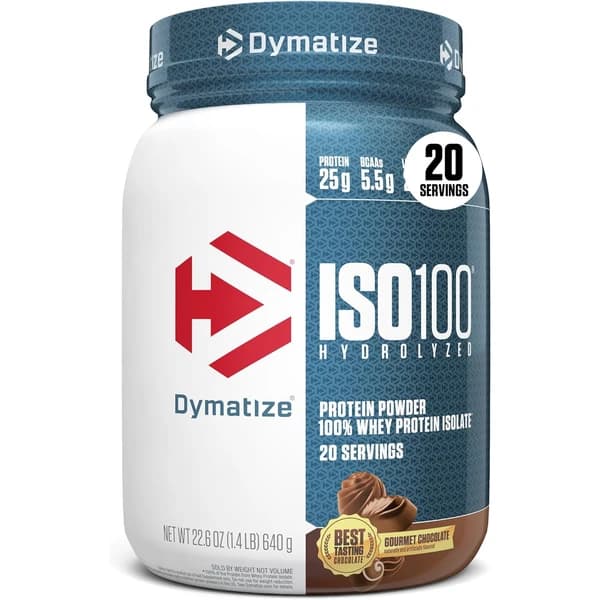
The biggest complaint from beginners is that protein targets feel impossibly high. Chicken, eggs, and Greek yogurt do most of the work, but a whey shake is the cheapest, fastest way to close a 20–30 g gap without meal-prepping more food. One scoop after training plus one with breakfast can add up to 50 g of high-quality protein in under two minutes.
Amazon · Affiliate
Dymatize ISO100 Whey Protein Isolate
4.7
Fast-absorbing whey isolate with 25g protein and under 1g of fat and sugar per serving. Great for post-workout.
$35–$60Check Price on Amazon
Comparison — protein per dollar:
- Chicken breast (boneless): ~22 g protein per $1.50 = 14.6 g/$
- Eggs (large): ~6 g protein per $0.25 = 24 g/$
- Whey protein isolate: ~24 g per $0.85 serving = 28 g/$
Whey isn't magic — it's a convenience tool. But for beginners fighting appetite or busy schedules, it turns "I can't hit 150 g of protein" into a non-issue.
Step 4: Pick a Tracking App
The right app removes 90% of the friction. Here's how the three most-used options stack up for beginners:
| App | Best For | Food Database | Barcode Scan | Free Tier | |---|---|---|---|---| | MyFitnessPal | Social features, huge database | 14M+ foods | Yes | Limited (premium required for macros) | | Cronometer | Accuracy + micronutrient tracking | ~1.3M curated | Yes | Full macros + 60+ micros free | | Lose It! | Simple UI, fast logging | ~10M foods | Yes | Solid free tier |
Beginner recommendation: Start with Cronometer if you care about accuracy (each food entry is verified), or Lose It! if you want the friendliest interface. MyFitnessPal's database is largest but notoriously crowdsourced — you'll often find duplicate entries with wildly different values.
Expert tip: Whichever app you choose, spend one evening building a list of 15–20 "staples" (your usual breakfasts, snacks, and go-to meals). After that, daily logging takes under 3 minutes.
Step 5: Weigh Your Food — It Makes or Breaks Your Numbers
Visual portion estimation is the single biggest source of tracking error for beginners. A 2013 Cornell study found that eyeballing portions produces errors of 30–40% on average — meaning you could be eating 300–500 more calories than your log shows and have no idea why the scale isn't moving.
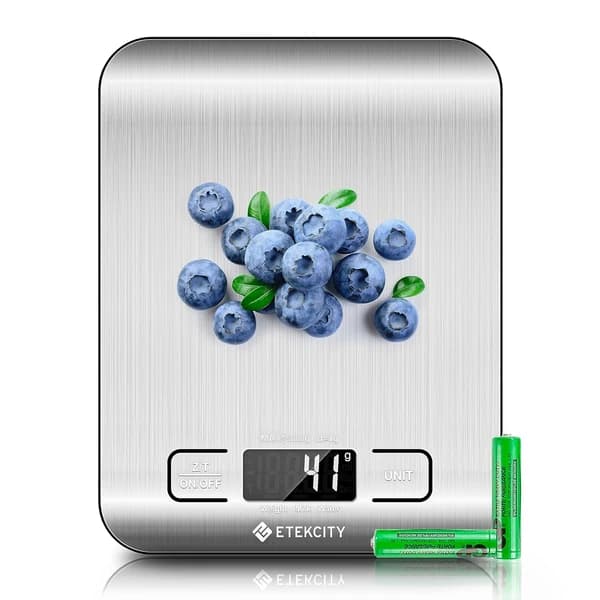
A digital food scale solves this instantly. It's the cheapest intervention in nutrition with the highest accuracy payoff.
Amazon · Affiliate
Etekcity Digital Food Scale (0.1g precision)
4.7
Measures in grams, ounces, pounds, and milliliters. Tare function, backlit display, auto-off. Essential for accurate macro tracking.
$10–$16Check Price on Amazon
What to weigh and what you can skip:
- Always weigh: oils, nut butters, grains, meat, cheese, nuts — all high-calorie-density foods where small errors compound fast
- Can eyeball: leafy greens, non-starchy vegetables, black coffee — low-calorie-density foods where errors are small in absolute terms
Once you've weighed your usual portions for two weeks, you'll develop a reliable visual calibration for your most common foods. Most people drop the scale for familiar items and only reach for it with new recipes.
Step 6: Don't Forget Micronutrients
Calorie counting can quietly push out variety, especially in a fat-loss phase. When you eat 300–500 calories less per day, you also tend to eat less produce, which means fewer vitamins and minerals. A 2022 review in Nutrition Reviews reported that more than 75% of American adults fail to meet the RDA for magnesium, vitamin D, or both — and that figure climbs during caloric deficits.
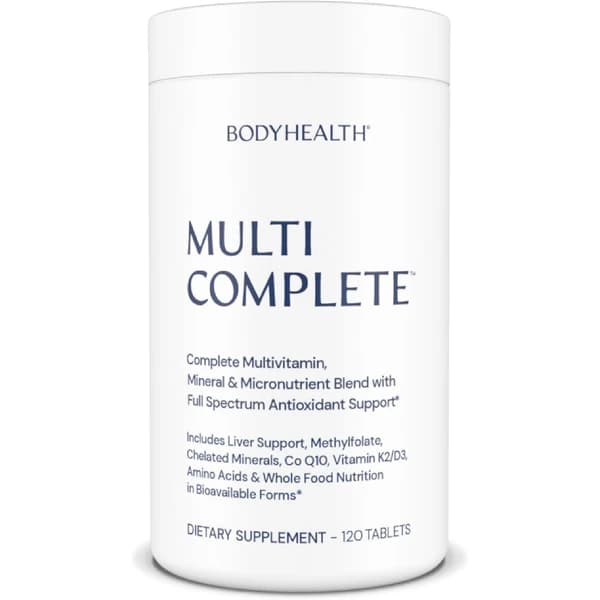
A daily multivitamin is the cheapest form of nutritional insurance. For quality, two stand out:
Amazon · Affiliate
Thorne Basic Nutrients 2/Day
4.8
NSF Certified multivitamin for athletes. Highly bioavailable forms of key vitamins and minerals.
$35–$45Check Price on Amazon
Thorne is the choice for those who want NSF Certified for Sport testing, third-party verified ingredients, and a clinical-grade formulation trusted by pro-sports teams and Mayo Clinic researchers.

Amazon · Affiliate
Garden of Life Sport Multivitamin
4.6
Certified organic whole food multivitamin for athletes. Includes probiotics and antioxidants.
$30–$40Check Price on Amazon
Garden of Life offers a whole-food, USDA-organic formula — ideal if you prefer plant-based ingredients and want your multivitamin to come with probiotics and enzymes built in.
A multivitamin doesn't replace vegetables — but while you're learning to count calories, it ensures one bad week doesn't blow a hole in your baseline nutrition.
Step 7: The 5 Biggest Calorie-Counting Mistakes
Even motivated beginners hit the same pitfalls. Avoiding these five will put you ahead of 90% of first-time trackers.
1. Not weighing food. Eyeballing portions is wrong by an average of 30–40%, according to a 2013 Cornell study. A $15 food scale pays for itself in a single week of accuracy.
2. Forgetting oils and drinks. Olive oil is 120 calories per tablespoon. A latte is 180. A "healthy" homemade smoothie can easily hit 600. These are the silent killers of a calorie deficit.
3. Trusting "net" calories from fitness trackers. Wrist-based calorie burn estimates can be off by up to 93%, per a 2017 Stanford study. Don't "eat back" all the exercise calories — at most 50%.
4. Ignoring the weekends. A 2018 Obesity study showed people consume an average of 115 more calories per day on weekends, erasing nearly a full day's deficit by Sunday.
5. Quitting after one bad day. Consistency beats perfection. Missing 100% for one day matters far less than tracking 80% across four weeks.
Final Thoughts
Learning how to count calories for beginners isn't about rigid perfection — it's about building the awareness that turns nutrition from guesswork into a skill. The LBE System gives you a clear sequence: Load your numbers with a TDEE calculation, Balance your macros with a protein-first split, and Execute with consistent daily tracking for at least two weeks before making adjustments.
Weigh your food, especially in the first month. The 30–40% error rate from eyeballing is the reason most beginners plateau before they ever get started. A cheap food scale and a verified-database app like Cronometer close that gap almost immediately.
And remember the 20% error caveat: your deficit is a range, not a laser. If the scale doesn't move after three weeks of honest tracking, trim 100–150 calories and reassess — don't overhaul your entire approach. Small, data-driven corrections compound into big results. Your future self will thank you for the data.
Affiliate disclosure: Some links in this article are affiliate links. If you purchase through them, we may earn a small commission at no extra cost to you. We only recommend products we genuinely believe in.
About the author
Nathan reviews the research, tests the tools, and writes the guides at LeanBodyEngine — evidence-first, no sponsored content, no supplement shilling.
Related articles


Subscribe
Never miss a new article
Get an email whenever we publish a new fitness guide, supplement review, or workout plan. One short email per post — that's it.
Unsubscribe anytime. We only email when there's a new post.