
Tongkat Ali and Testosterone: Separating the Science from the Supplement Hype
Tongkat ali went viral after Huberman endorsed it. The clinical evidence tells a more specific story, not the one supplement companies want you to hear.

Tongkat ali is the testosterone supplement of the moment. Andrew Huberman — Stanford neuroscientist and one of the most-followed health podcasters on the planet — called it one of the most potent natural testosterone-supporting compounds and publicly stated his own levels climbed roughly 200 ng/dL after adding it to his stack. Supplement sales surged. The combination of tongkat ali and fadogia agrestis became the testosterone-optimization shortcut everyone was talking about on Reddit, in gym locker rooms, and across YouTube.
Here's what the actual clinical research shows — and why the reality is both more specific and more interesting than the hype.
The headline: tongkat ali is not a universal testosterone booster. It is a context-dependent intervention. The evidence for meaningful effects is real, but it is concentrated in a specific population: men with clinically low or borderline-low testosterone, aging men with androgen deficiency, and men under chronic psychological stress. In healthy young men with normal testosterone sitting comfortably in the mid-to-upper reference range, the effect exists but is statistically marginal and clinically small. That distinction — between restoring what's been lost versus amplifying what's already there — is the one the supplement industry has no financial incentive to make clearly.
Let's dig into the data.
Key Takeaways
- Tongkat ali (eurycoma longifolia) has real clinical evidence for increasing testosterone — but primarily in hypogonadal men (T < 300 ng/dL) and aging men with androgen deficiency.
- In healthy young eugonadal men, the 2022 meta-analysis showed a non-significant effect (SMD = 0.760, p = 0.249) in that subgroup specifically.
- The total meta-analysis looks impressive (SMD = 1.352), but it's driven by the hypogonadal subgroup (SMD = 1.861) and suffers from high heterogeneity (I² = 87.27%).
- Only 5 RCTs with 232 participants total have been included in the best available meta-analysis — the evidence base is thin.
- Vitamin D deficiency correction has stronger evidence per capita, corrects a genuine driver of suboptimal testosterone, and costs a fraction of the price.
- Ashwagandha (KSM-66) outperforms tongkat ali for stress-related testosterone suppression because it addresses cortisol — the more proximate cause.
- Fadogia agrestis, Huberman's other recommendation, has zero published human trials and documented animal toxicity at high doses.
The Huberman Effect: What He Actually Said
To be fair to Huberman, his recommendation was more nuanced than the supplement industry's subsequent marketing. He suggested 400 mg/day of a standardized tongkat ali extract (10% eurycomanone), acknowledged this was based on mechanistic data and limited clinical evidence, and recommended blood testing before and after supplementation to see if it actually worked for you individually.
What happened next is a predictable story in supplement culture. The nuance got stripped. The "try it with blood tests and see" became "Huberman says tongkat ali raises testosterone 200 points." The conditional recommendation became an unconditional one. Sales of tongkat ali products reportedly increased by double-digit percentages in 2023 alone. Meanwhile, the actual research base that Huberman drew from consisted of fewer than a dozen published human trials — most of them small, most conducted in populations with pre-existing testosterone deficiency, and most sponsored by companies selling the Physta® branded extract.
That is not a reason to dismiss the evidence. It is a reason to read it carefully.
What the Research Actually Shows
The 2022 Meta-Analysis: The Best Data We Have
The most rigorous analysis of tongkat ali's testosterone effects comes from a 2022 systematic review and meta-analysis published in Medicina by Leisegang, Finelli, Sikka, and Panner Selvam. The authors screened available literature and identified 9 relevant studies, of which 5 RCTs (n = 232 participants total) met quality thresholds for inclusion in the meta-analysis.
Overall result: statistically significant increase in total testosterone (SMD = 1.352, 95% CI 0.565–2.138, p = 0.001).
That looks compelling. But the subgroup breakdown tells the real story:
- Hypogonadal men (low testosterone subgroup): SMD = 1.861 (95% CI 0.719–3.002, p = 0.002) — strongly significant
- Healthy volunteers (normal testosterone): SMD = 0.760 (95% CI −0.540 to 2.060, p = 0.249) — not significant
The overall result is being pulled by the hypogonadal subgroup. In men who already have normal testosterone, the pooled effect doesn't reach statistical significance. The heterogeneity across studies is also very high (I² = 87.27%), which means the studies are dissimilar enough that pooling them warrants caution. The authors themselves note "limited sample sizes" and high heterogeneity as key limitations.
Individual Studies: Effect Sizes in Context
| Study | Year | N | Population | Dose | Duration | T Change | Quality | |---|---|---|---|---|---|---|---| | Tambi et al. | 2012 | 76 | Hypogonadal men (LOH) | 200 mg/day | 1 month | 35.5% → 90.8% in normal range | Moderate | | Chinnappan et al. | 2021 | 105 | Males 50–70, T < 300 ng/dL | 100–200 mg/day | 12 weeks | +16.5 to +24.5 ng/dL (~9–12%) | Good | | Leitão et al. | 2021 | 45 | Aging males, ADAM criteria | 200 mg/day | 6 months | 278 → 400 ng/dL (+44%) | Good | | Chan et al. | 2021 | 32 | Healthy young men, age ~24 | 600 mg/day | 2 weeks | Sig. increase (abs. not reported) | Fair | | Leisegang meta | 2022 | 232 | Mixed (5 RCTs) | 100–600 mg/day | 3 days–6 months | SMD 1.352 overall | Moderate |
The Chinnappan et al. (2021) study is particularly instructive. It's one of the better-designed trials: double-blind, placebo-controlled, multicentre, with proper ethics review. The 200 mg group moved from 200.5 ng/dL to 225.0 ng/dL over 12 weeks. That's a clinically significant improvement — when your starting point is 200.5 ng/dL. But it's also a 24.5 ng/dL absolute increase in a population that was already testosterone-deficient. The study population was specifically selected for T < 300 ng/dL.
The 2021 Chan et al. study of healthy young men (mean age 24.4) used 600 mg/day — a higher dose than most protocols — for two weeks and found statistically significant increases in total and free testosterone. Importantly, the mechanism appeared to involve HPA axis activation rather than direct gonadal stimulation (LH and FSH did not change significantly). This is mechanistically interesting but also complicates the simple "tongkat ali raises testosterone" narrative: if LH is not going up, you're not necessarily signaling the testes to produce more testosterone via the primary hormonal pathway.
Myth vs. Reality: Testosterone Supplement Edition
Myth 1: "Tongkat ali raises testosterone by 100–200 ng/dL in most men."
Reality: That magnitude of effect was observed in Huberman's self-reported n=1 experiment. In the clinical literature, absolute increases in hypogonadal populations range from approximately 16–122 ng/dL depending on baseline and dose. In eugonadal men, the pooled effect is not statistically significant. Individual results vary considerably, and Huberman himself recommended blood testing before and after to confirm a personal response — a recommendation that got lost in the marketing translation.
Myth 2: "More testosterone boosters = more testosterone."
Reality: Testosterone operates within a tightly regulated feedback loop (the HPG axis). Supplements that work by increasing LH may see diminishing returns as the pituitary detects rising testosterone and downregulates signaling. This is why stacking multiple "T-boosters" rarely produces additive effects and may produce none. The better question is: what is suppressing your testosterone in the first place?
Myth 3: "Natural testosterone support is risk-free."
Reality: Tongkat ali at tested doses (100–600 mg/day of standardized extract) has a reasonable short-term safety profile in published trials. Fadogia agrestis — Huberman's other recommendation — is a different story: no published human trials exist, and rodent studies have documented testicular toxicity at higher doses. The dose-response curve in humans is entirely unknown. "Natural" is not synonymous with "safe at any dose."
The LBE Testosterone Stack: A Tier System
Not all testosterone support interventions are created equal. Here is how to think about prioritization based on evidence quality, cost, and population specificity.
Tier 1: Foundational — Do This First (Everyone)
Before buying any specialized supplement, address the most common, most evidence-backed suppressors of testosterone. These are modifiable lifestyle and micronutrient factors.
Vitamin D3 deficiency correction is the single most evidence-backed intervention for suboptimal testosterone in men who are actually deficient — and most men in northern latitudes or with indoor lifestyles are. A 2022 meta-analysis of 17 RCTs involving 1,774 men found that vitamin D supplementation significantly increased total testosterone (WMD 0.38, p < 0.05), with the effect more pronounced in men who were deficient at baseline and in doses exceeding 4,000 IU/day. The mechanism is direct: vitamin D receptors are expressed in Leydig cells (the testosterone-producing cells in the testes), and vitamin D appears to stimulate testosterone synthesis enzymatically.
The cost is roughly $0.10–0.20 per day. It addresses a real deficiency that the majority of supplement buyers have and are unaware of.
Amazon · Affiliate
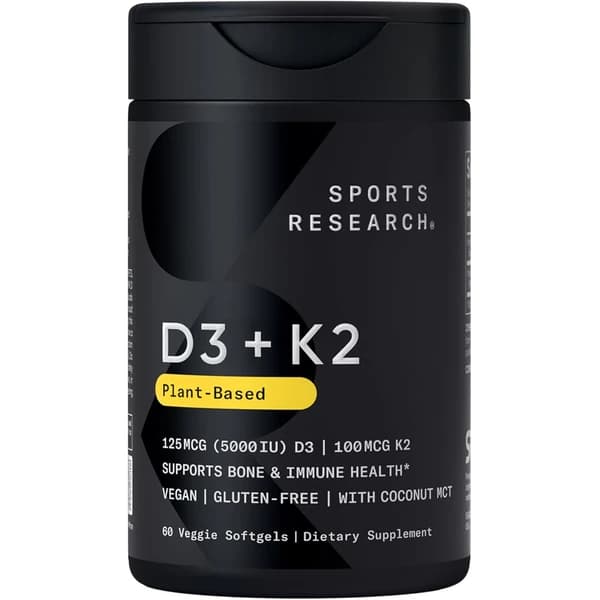
Sports Research Vitamin D3 + K2 (5000 IU)
4.7
Bioavailable D3 paired with K2 for calcium regulation. Supports bone density, immunity, and testosterone levels.
$15–$22Check Price on Amazon
Sleep quality is not a supplement but deserves Tier 1 status: one night of sleep restriction to 5 hours reduces testosterone by 10–15% in healthy young men (Leproult & Van Cauter, 2011). Fix sleep before buying anything.
Micronutrient adequacy matters because zinc, magnesium, and several B vitamins are rate-limiting cofactors in steroidogenesis. Athletes in a caloric deficit or training heavily are at highest risk of depletion. A pharmaceutical-grade multivitamin closes these gaps inexpensively.
Amazon · Affiliate
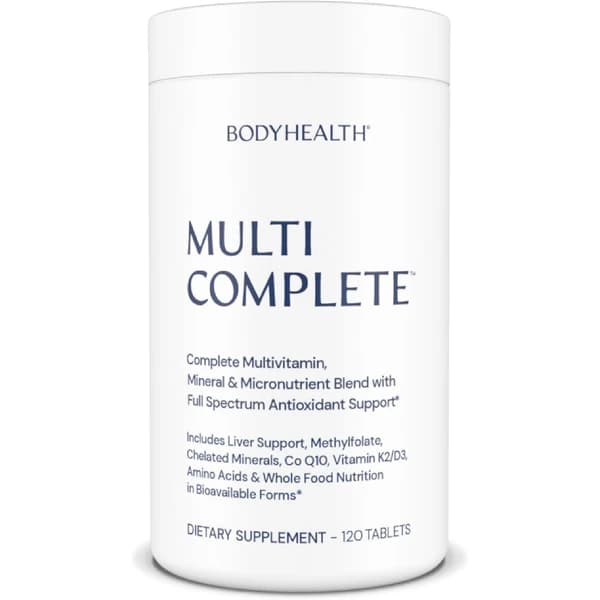
Thorne Basic Nutrients 2/Day
4.8
NSF Certified multivitamin for athletes. Highly bioavailable forms of key vitamins and minerals.
$35–$45Check Price on Amazon
Tier 2: Evidence-Backed Enhancers — Condition-Specific
These supplements have real clinical evidence but work through specific mechanisms that may or may not apply to you. They are not universally useful.
Tongkat ali (eurycoma longifolia, standardized to 10% eurycomanone, 200–400 mg/day):
- Who benefits: Men with clinically low testosterone (< 300 ng/dL), aging men with ADAM/LOH, men under significant chronic psychological stress.
- Who likely does not benefit meaningfully: Healthy young men with testosterone already in the 500–900 ng/dL range.
- Evidence grade: Moderate (5 RCTs, 232 participants, high heterogeneity, mostly industry-funded).
- Expected effect if you're in the target population: +10–44% testosterone, normalization of borderline-low levels over 4–12 weeks.
Ashwagandha (KSM-66 or Sensoril standardized extract, 300–600 mg/day): For stress-related testosterone decline, ashwagandha has mechanistic and clinical advantages over tongkat ali. While tongkat ali may work by supporting androgenic hormone production directly, ashwagandha works primarily by reducing cortisol. Because cortisol and testosterone share a biosynthetic precursor (pregnenolone), chronically elevated cortisol suppresses testosterone production — a documented phenomenon in overtrained athletes, men with high work stress, and sleep-deprived individuals. If chronic stress is your primary driver, lowering cortisol is attacking the root cause.
A 2022 RCT of 50 males with lower sexual desire found the KSM-66 group increased total testosterone by 96.2 ng/dL versus 18.0 ng/dL in placebo. A 12-week trial in 176 healthy American men found 600 mg/day of KSM-66 increased testosterone 14–17% versus placebo. The cortisol reduction has been consistently replicated across multiple RCTs with effect sizes of 10–30%.
Amazon · Affiliate
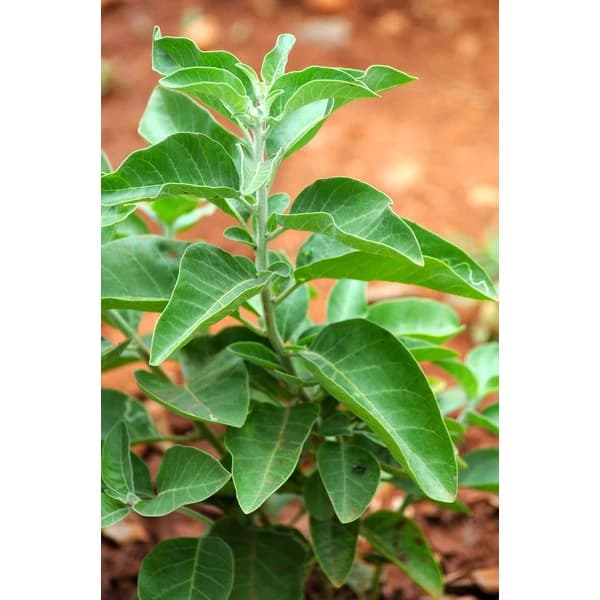
Jarrow Formulas Ashwagandha (KSM-66)
4.6
300mg KSM-66 ashwagandha root extract. Clinically studied to reduce cortisol, improve sleep quality, and boost strength.
$15–$25Check Price on Amazon
Tier 3: Speculative — Insufficient Human Evidence
Fadogia agrestis: Zero published human RCTs. Rodent studies only. Animal toxicity data at high doses is concerning (testicular histopathology in several studies). Until human trials with appropriate safety monitoring exist, this is a supplement to wait on regardless of who is endorsing it.
Boron, fenugreek, and pine pollen: Some mechanistic rationale and small studies exist for each. Effect sizes in well-designed RCTs are modest and inconsistent. Not worth prioritizing over Tier 1 and Tier 2 interventions.
Tongkat Ali vs. Ashwagandha vs. Vitamin D3: A Comparative Look
| Supplement | Primary Mechanism | Best For | RCTs (Human) | Avg. T Increase | LBE Verdict | |---|---|---|---|---|---| | Tongkat Ali | LH stimulation, SHBG reduction, androgenic effects | Hypogonadal men, aging men, LOH | ~9 (5 RCTs in meta) | +10–44% (hypogonadal); NS in eugonadal | Use if T < 300 ng/dL or aging | | Ashwagandha (KSM-66) | Cortisol reduction, HPA axis regulation | Stress-related T suppression, overtrained athletes | 8+ RCTs | +14–17% (eugonadal); +96 ng/dL in some trials | Better all-around choice for stressed, active men | | Vitamin D3 (5000 IU) | Direct Leydig cell stimulation, steroidogenesis | Deficient men (most gym-goers) | 17 RCTs (meta 2022) | +0.38 WMD (modest but consistent) | Do this first — it's free to fix a real problem |
The important takeaway from this table: ashwagandha has a broader evidence base in eugonadal men and a cleaner mechanistic story for the most common scenario (stress + training = suppressed T). Tongkat ali is more appropriate for clinical hypogonadism. Vitamin D3 comes first because deficiency is rampant and the fix is cheap.
Who Should and Shouldn't Buy Tongkat Ali
Buy it (conditionally) if:
- Your bloodwork shows testosterone below 300 ng/dL (clinical hypogonadism threshold) or in the 300–400 ng/dL borderline range
- You're over 45 and experiencing symptoms consistent with androgen deficiency in aging males (fatigue, reduced libido, decreased muscle mass)
- You've already addressed sleep, vitamin D, zinc/magnesium, and stress — and still have suboptimal testosterone
- You're willing to test bloodwork before and 8–12 weeks after to objectively evaluate your personal response
Skip it (for now) if:
- Your testosterone is 500 ng/dL or above and you're hoping to push into the 900+ range — the evidence does not support this use case
- You're under 35, training consistently, sleeping well, and are nutritionally replete — you almost certainly have more effective levers to pull
- You haven't corrected vitamin D deficiency and sleep quality first — you'd be spending $40/month on a Tier 2 supplement while ignoring Tier 1 problems that cost $0.15/day to fix
- You're primarily attracted by the Huberman endorsement without having the bloodwork to confirm you're in the population the studies were conducted in
The Evidence Problem Nobody Talks About
The clinical evidence for tongkat ali, while real, has a structural problem: almost all of the well-designed trials use Physta® — a proprietary standardized water extract manufactured by Biotropics Malaysia, the company with the strongest financial interest in positive outcomes. This is not unique to tongkat ali (most supplement research has industry involvement), but it is worth noting.
The independent replication that would settle questions about effect magnitude in different populations largely does not exist. The 2022 meta-analysis's high heterogeneity (I² = 87.27%) tells you the studies are measuring something real but that the effect size varies considerably based on factors the current literature can't fully explain. Dose, population, extract standardization, and duration all matter — and none of the studies are identical enough to give you a clean pooled estimate you can apply to yourself.
For comparison, creatine monohydrate — the most evidence-backed strength supplement in existence — has hundreds of independent RCTs across dozens of laboratories with consistent effect sizes. Vitamin D has 17 meta-analyzed RCTs. Tongkat ali has 5 RCTs in the best available meta-analysis, with 232 total participants and an acknowledged industry funding problem.
That doesn't make tongkat ali ineffective. It makes the evidence base immature.
Dosing and Practical Guidance
If you've done the prerequisite work (corrected vitamin D, optimized sleep, managed training load) and your bloodwork indicates you're in the target population, here is how to use tongkat ali intelligently:
- Extract specification: Look for a standardized extract (Physta® or equivalent) standardized to 0.8–1.5% eurycomanone or 10% eurycomanone depending on the assay method. Raw root powder is not equivalent.
- Dose: 200–400 mg/day. Most positive trials used 200 mg/day. The Chan et al. (2021) study in young men used 600 mg/day for two weeks; no long-term safety data exists at 600 mg.
- Duration before assessment: 8–12 weeks minimum. Do not evaluate efficacy before 8 weeks.
- Test: Baseline bloodwork and repeat at 8–12 weeks. Look at total testosterone, free testosterone, SHBG, and LH. If SHBG is high (a common reason for low free T despite normal total T), tongkat ali's SHBG-lowering effect may be specifically relevant to you.
- Cycling: The clinical evidence does not specifically support cycling, but given that the longest published trial is 6 months, long-term continuous use is unstudied. Taking breaks every 3–4 months is reasonable precaution.
Final Thoughts
Is tongkat ali worth buying?
Conditionally, yes — if you are in the right population.
If your testosterone is clinically low or borderline-low (confirmed by bloodwork), you are over 40, and you have already addressed the foundational factors (sleep, vitamin D, micronutrient status, stress), tongkat ali is a reasonable addition to your protocol with a genuine evidentiary basis. The Chinnappan et al. (2021) and Leitão et al. (2021) trials are solid work. The meta-analysis finding in hypogonadal men is statistically robust even if the evidence base is small. A meaningful proportion of men in these populations will see clinically significant improvements.
If your testosterone is normal, you are under 35, and you are primarily drawn by the supplement's viral moment — the Huberman endorsement, the Reddit threads, the before-and-after anecdotes — the honest answer is that the evidence does not reliably support your use case. You are likely spending $40–60/month on a marginal effect that a vitamin D repletion protocol and better sleep hygiene would outperform.
The supplement industry has one playbook: take a real effect observed in a specific clinical population and market it as universal. Tongkat ali's real story — "meaningfully effective in hypogonadal and aging men, less clear in healthy eugonadal men, requires blood testing to evaluate, works through mechanisms that compete poorly with cortisol management and vitamin D in most gym-goers" — is not a story that sells supplements. But it is the story the data tells.
Read the data.
Affiliate disclosure: Some links in this article are affiliate links. If you purchase through them, we may earn a small commission at no extra cost to you. We only recommend products we genuinely believe in.
About the author
Nathan reviews the research, tests the tools, and writes the guides at LeanBodyEngine — evidence-first, no sponsored content, no supplement shilling.
Related articles
Subscribe
Never miss a new article
Get an email whenever we publish a new fitness guide, supplement review, or workout plan. One short email per post — that's it.
Unsubscribe anytime. We only email when there's a new post.